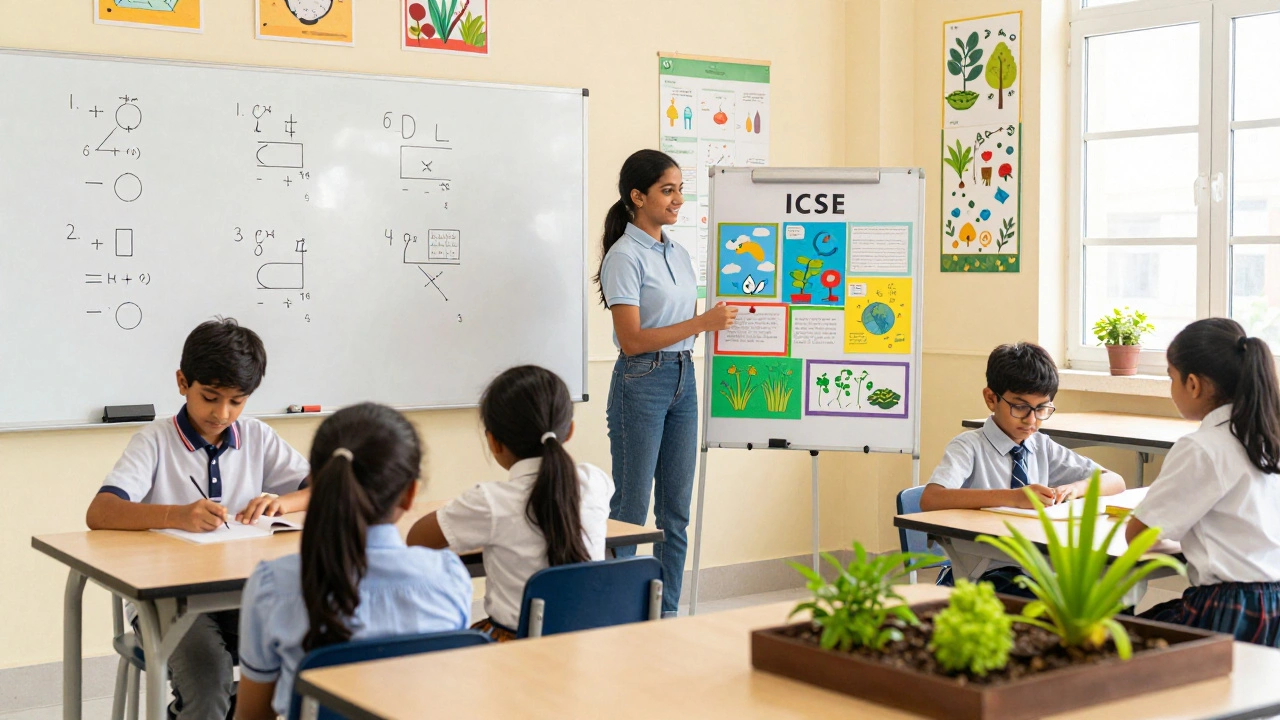
Syllabus Matchmaker Tool
Find the Best Syllabus for Your Child
This tool analyzes your child's learning style, strengths, and family circumstances to recommend the most suitable educational syllabus from CBSE, ICSE, or State Boards.
Answer a few questions
Choosing the right syllabus for your child isn’t about picking the hardest or the most popular one. It’s about matching the structure, pace, and focus to how your child learns best. In India, three main syllabi dominate: CBSE, ICSE, and state boards. Each has strengths and trade-offs, and the ‘best’ one depends on your child’s goals, learning style, and future plans.
What Makes a Syllabus Good for Kids?
A good syllabus for young learners doesn’t just cover subjects-it builds confidence, curiosity, and critical thinking. Kids under 12 need structure but also room to explore. They learn best when lessons connect to real life, not just memorization. The best syllabi for this age group balance core skills-reading, math, science-with creativity and communication.
CBSE, ICSE, and state boards all teach the same basic subjects: English, Math, Science, Social Studies, and a regional language. But how they teach them? That’s where the differences matter.
CBSE Syllabus: Streamlined and Exam-Focused
CBSE (Central Board of Secondary Education) is the most widely followed syllabus in India, used by over 20,000 schools. It’s designed for clarity and consistency. The curriculum is compact, with fewer topics but deeper focus on core concepts in Science and Math.
For example, in Class 5, CBSE teaches fractions and decimals in Math with practical word problems. In Science, kids learn about the human body through labeled diagrams and simple experiments. The language is direct. There’s little fluff. This helps kids who thrive on routine and clear expectations.
CBSE also prepares students early for national exams like JEE and NEET. By Class 8, students are already exposed to the format and pressure of competitive exams. That’s a plus if your child is aiming for engineering or medical careers. But it also means less time for creative writing, literature analysis, or project-based learning.
ICSE Syllabus: Broader, Deeper, More Balanced
ICSE (Indian Certificate of Secondary Education), run by CISCE, offers a more rounded education. It’s known for heavier emphasis on English, literature, and project work. A Class 6 student in ICSE might write a 500-word essay on climate change, conduct a survey on water usage at home, and present findings in class.
Science and Math are taught with more detail. For instance, while CBSE might cover the water cycle in one chapter, ICSE breaks it into subtopics like evaporation, condensation, precipitation-with real-world case studies. English isn’t just grammar and vocabulary; it includes poetry, drama, and critical reading from global authors.
ICSE students often score higher in verbal reasoning and communication skills. But the workload is heavier. A typical ICSE student spends 10-12 hours a week on homework, compared to 6-8 for CBSE. That’s fine for kids who enjoy reading and writing, but overwhelming for those who learn better through hands-on activities or visual aids.
State Board Syllabi: Local, Practical, Flexible
State boards vary widely. Maharashtra’s MSBSHSE, Tamil Nadu’s TN Samacheer, and Karnataka’s SSLC all follow their own rules. But they share common traits: strong focus on regional language, local history, and practical applications.
In Karnataka, a Class 4 Science lesson might involve visiting a nearby farm to study crop rotation. In Maharashtra, Social Studies includes detailed lessons on Maratha history. These syllabi are often simpler than CBSE or ICSE, making them easier for kids who struggle with dense textbooks.
State boards are ideal if your child will stay in the state for higher education. Many state universities give preference to state board students. They’re also less expensive-textbooks cost less, coaching isn’t as necessary, and the exam pattern is predictable.
But if you’re planning to move cities or apply to national colleges later, state board students sometimes face challenges. The syllabus isn’t always aligned with JEE or NEET, and some private colleges ask for additional entrance tests.
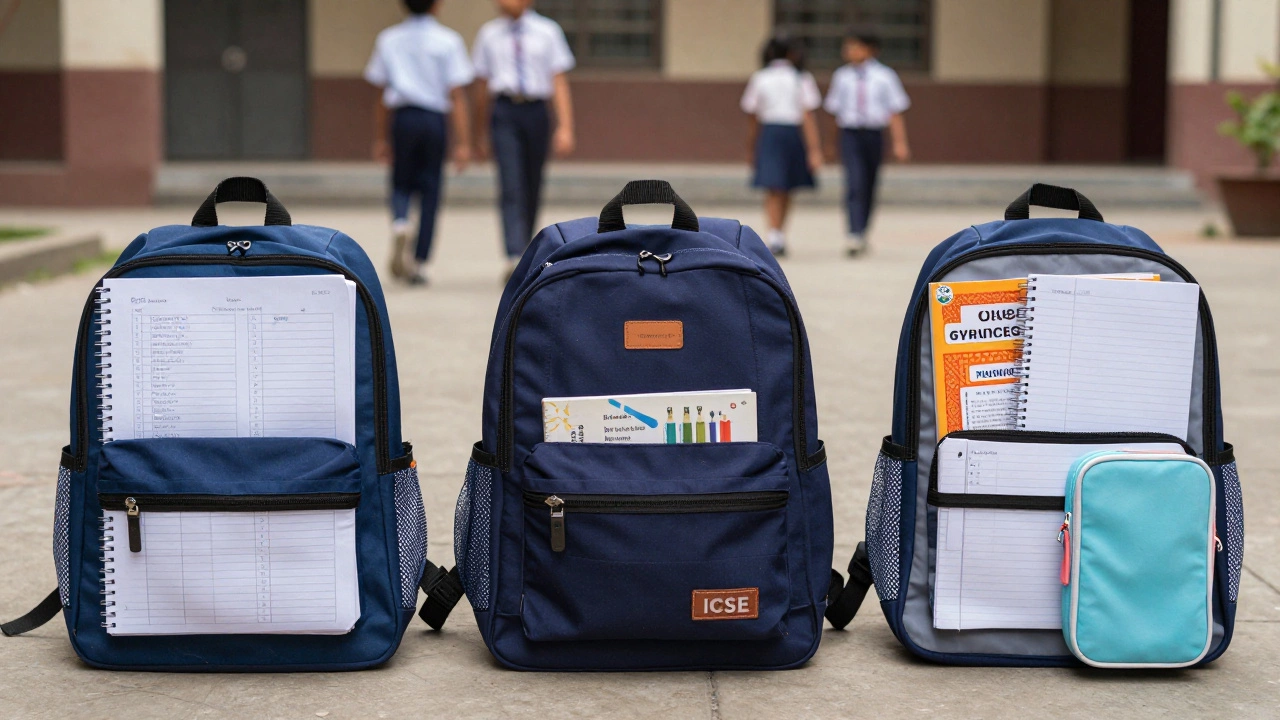
How Do They Compare in Real Life?
Let’s look at a typical week for a 10-year-old in each system:
| Area | CBSE | ICSE | State Board |
|---|---|---|---|
| Science Depth | Core concepts, exam-focused | Detailed theory + experiments | Practical, local context |
| English Load | Grammar + comprehension | Literature, essays, poetry | Basic fluency + regional language |
| Homework Hours/Week | 6-8 hours | 10-12 hours | 5-7 hours |
| Project Work | Minimal | Heavy-research, presentation | Occasional, community-based |
| Prep for Competitive Exams | Strong from Class 8 | Moderate | Weak-requires extra coaching |
These differences aren’t just academic-they shape how kids see learning. A CBSE student might say, “I need to get this formula right.” An ICSE student says, “I want to understand why this happens.” A state board student says, “This is how my uncle does it in the village.” All are valid. None is universally better.
Who Benefits Most From Each Syllabus?
Choose CBSE if:
- Your child is goal-oriented and likes clear rules
- You plan to move cities or live in a metro area
- Your child might take JEE, NEET, or other national exams
- You prefer standardized, predictable testing
Choose ICSE if:
- Your child loves reading, writing, and asking questions
- You want strong English skills for global opportunities
- Your child thrives with projects and presentations
- You’re okay with higher workload and more parental involvement
Choose State Board if:
- Your family is rooted in one region
- Your child learns better through real-life examples
- You want lower costs and less pressure
- Your child isn’t aiming for top national colleges yet
What Most Parents Get Wrong
Many parents pick CBSE because it’s “the most popular.” Others choose ICSE because they think it’s “better.” But popularity doesn’t equal suitability.
A 2023 study by NCERT tracked 1,200 students across three syllabi from Class 3 to Class 8. It found no significant difference in final academic outcomes between CBSE and ICSE students when parental support and school quality were equal. The biggest factor? Engagement. Kids who were curious and asked questions did better-no matter the syllabus.
Another mistake: switching syllabi mid-way. Changing from CBSE to ICSE in Class 5 can cause confusion. The jump in English and project work is steep. Kids often lose confidence. Stability matters more than prestige.
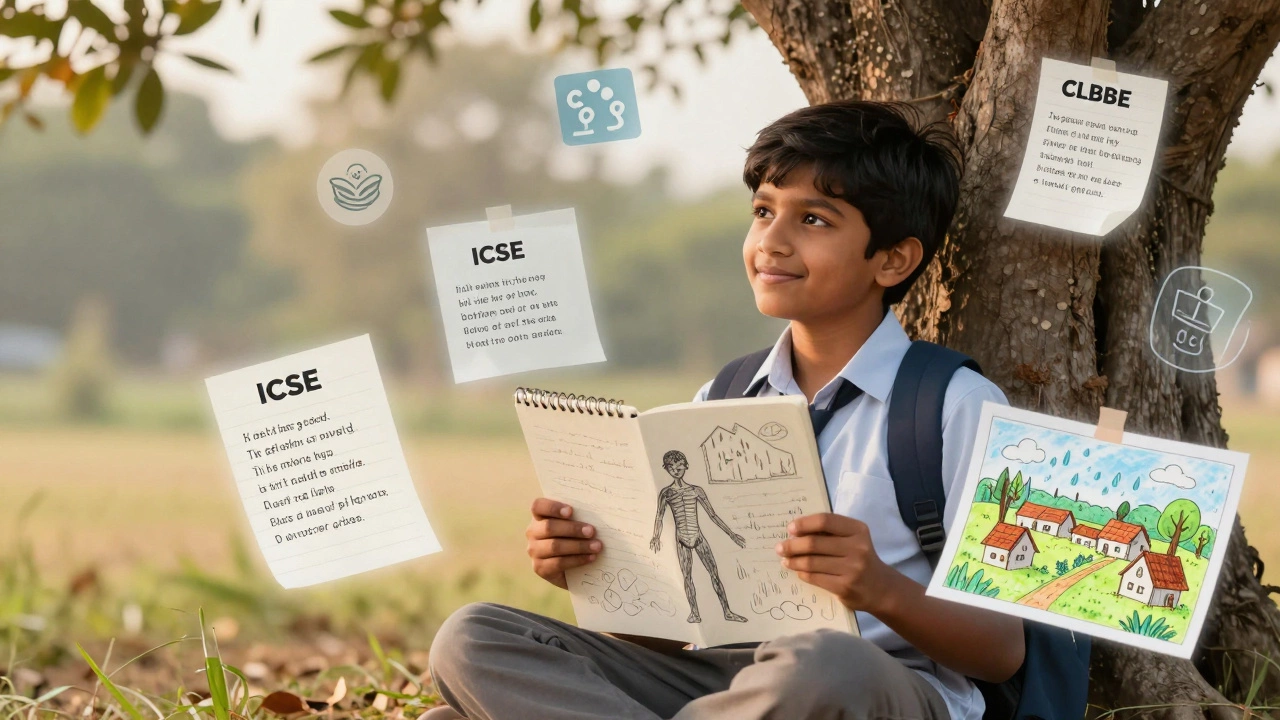
What About Kids With Learning Differences?
If your child has dyslexia, ADHD, or struggles with memory, ICSE’s heavy reading load can be a barrier. CBSE’s simpler language and focus on visuals can help. State boards, with their practical approach, often include more hands-on learning-ideal for kinesthetic learners.
Many schools now offer inclusive education under the RTE Act. Ask if the school has resource rooms, extra time in exams, or simplified worksheets. A good school adapts the syllabus to the child-not the other way around.
Final Tip: Talk to Your Child
Don’t decide based on what your neighbor chose. Ask your child: “What do you like doing in school?” “Do you prefer drawing diagrams or writing stories?” “Do you get tired after homework?”
Some kids thrive on structure. Others need space to wonder. The best syllabus isn’t the one with the most prestige-it’s the one that lets your child feel smart, not stressed.
Is CBSE easier than ICSE?
CBSE is often seen as easier because it has fewer topics and simpler language. But that doesn’t mean it’s less challenging. ICSE covers more depth and requires stronger writing skills. What’s easy depends on your child’s strengths. A child who loves writing may find ICSE easier, while one who prefers math and science might prefer CBSE.
Can I switch from CBSE to ICSE in Class 6?
Yes, but it’s tough. ICSE introduces advanced English literature, detailed science concepts, and frequent projects starting in Class 5. A child switching at Class 6 may struggle with the sudden increase in workload and writing expectations. Schools usually require a transfer certificate and may give a placement test. It’s better to switch before Class 5 or wait until high school.
Does state board affect college admissions?
For state universities, no-it’s often an advantage. For national colleges like IITs or AIIMS, state board students need to prepare separately for JEE or NEET, since those exams are based on CBSE patterns. Many state board students take extra coaching to bridge the gap. It’s possible to get in, but it requires more effort.
Which syllabus is best for a child who wants to study abroad?
ICSE is the strongest choice for studying abroad. Its focus on English literature, critical thinking, and project work aligns well with international curricula like IB or Cambridge. CBSE is also accepted, but students often need to take additional English proficiency tests. State boards may require more documentation to prove academic equivalence.
Should I choose a school based on the syllabus or the teachers?
Teachers matter more than the syllabus. A great teacher can make even a rigid syllabus engaging. A poor teacher can make the best curriculum feel boring. Visit schools, talk to current parents, and watch how kids interact with their teachers. The right environment can turn any syllabus into a good fit.
What Comes Next?
Once you’ve picked a syllabus, the real work begins-not with textbooks, but with conversations. Ask your child what they learned today. Let them explain it in their own words. Encourage questions, even if they seem silly. Learning isn’t about checking boxes-it’s about building a mind that keeps growing.