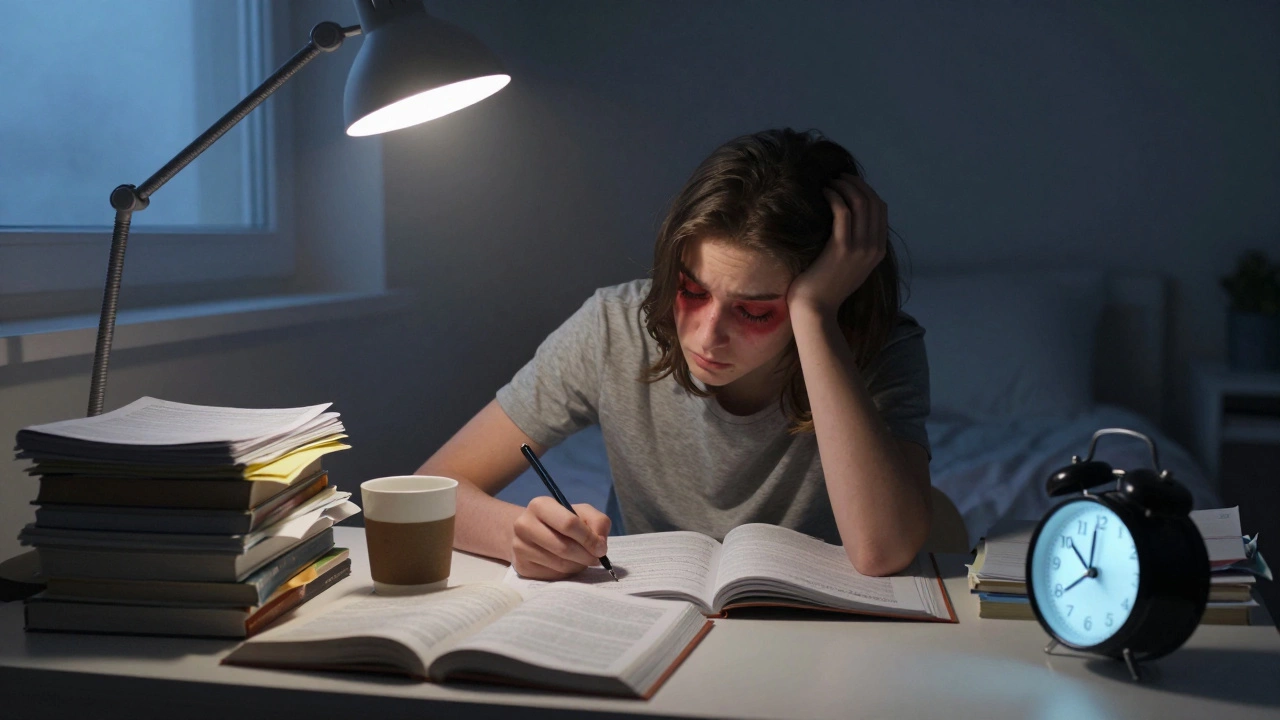
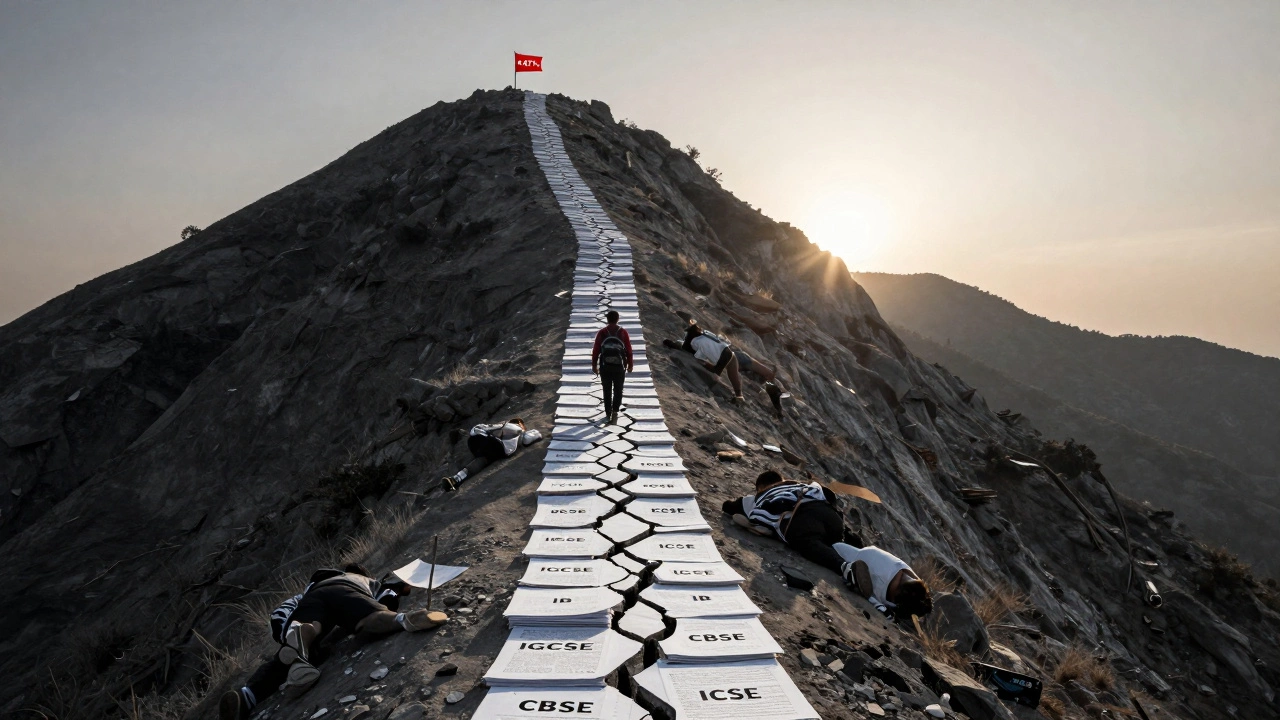
Ask any student who’s switched from CBSE to IB, or from ICSE to IGCSE, and they’ll tell you one thing: not all school syllabi are created equal. Some feel like climbing a mountain with no summit. Others feel like walking a tightrope over a canyon-constant pressure, zero room for error. The question isn’t just which syllabus is hardest-it’s which one demands the most from your mind, your time, and your resilience.
CBSE: The High-Stakes Grind
The Central Board of Secondary Education (CBSE) syllabus in India is often called the hardest not because it’s the most complex, but because of what it demands. Over 20 million students take CBSE exams every year. The pressure isn’t just academic-it’s cultural. Your board exam score doesn’t just determine your next grade; it decides whether you get into an IIT, a medical college, or a top engineering program. The syllabus itself isn’t full of obscure theories. It’s dense, linear, and unforgiving. Physics problems require memorizing 15+ formulas and applying them under timed conditions. Chemistry has over 200 reactions you must recall verbatim. Math doesn’t test creativity-it tests precision. One misplaced decimal, one wrong step, and you lose the entire mark.
CBSE’s structure is built for standardization. The exam pattern is rigid. The marking scheme is strict. There’s little room for interpretation. Students who thrive here don’t need genius-they need discipline. They wake up at 5 a.m., study until midnight, and repeat the cycle for two years straight. The syllabus doesn’t change much year to year. That’s not a comfort-it’s a trap. You’re expected to master the same content year after year, with no flexibility to explore.
IB: Depth Over Breadth, Pressure Over Peace
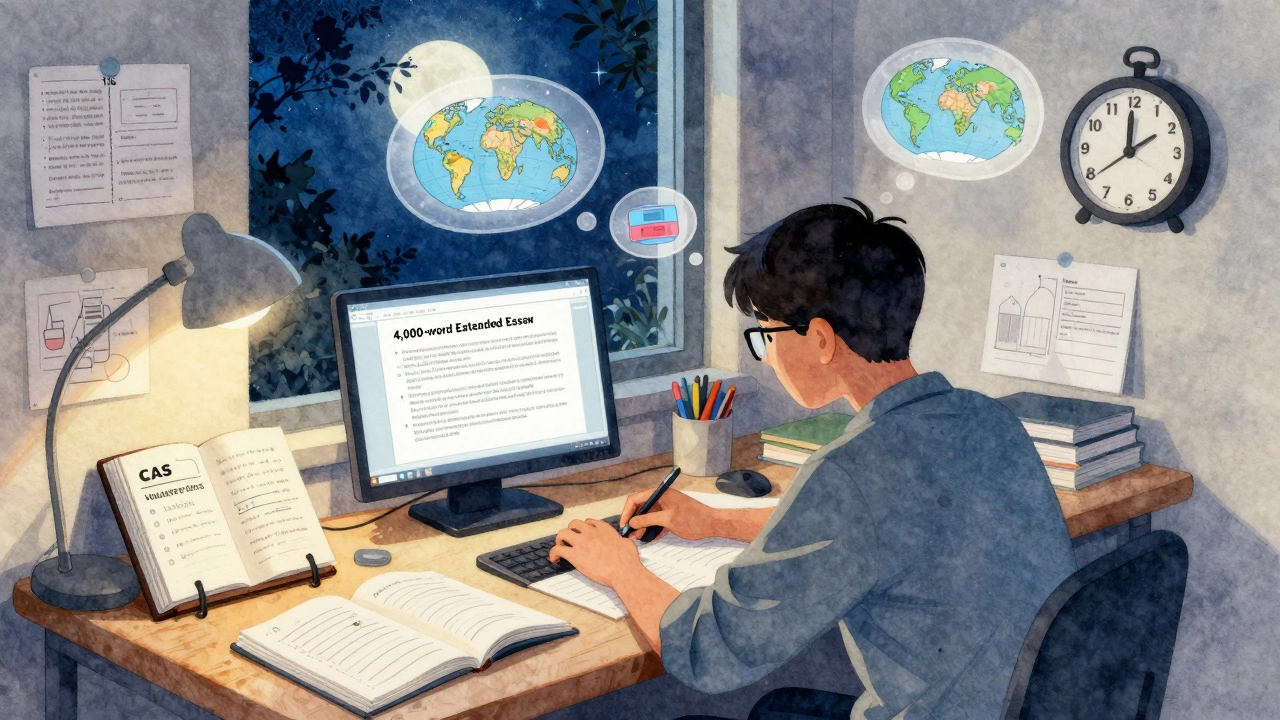
The International Baccalaureate (IB) Diploma Programme is the opposite of CBSE in structure, but just as brutal in execution. Where CBSE tests memory, IB tests thinking. Where CBSE asks for answers, IB asks for arguments. The IB curriculum spans six subject groups: language, literature, sciences, math, arts, and individuals and societies. You don’t just take biology-you write a 4,000-word Extended Essay on gene editing. You don’t just learn history-you analyze primary sources from three different continents.
IB students must also complete Theory of Knowledge (TOK), a course that forces you to question how you know what you know. Then there’s Creativity, Activity, Service (CAS)-60 hours of volunteer work, sports, or art projects-done on top of 40+ hours of weekly study. The exams are two years in the making. Final grades are based on internal assessments, oral presentations, lab reports, and written papers-all graded by teachers and externally moderated. A single low score in one area can tank your entire diploma. The IB doesn’t care if you’re exhausted. It cares if you can sustain excellence under pressure.
Studies from the IB Organization show that IB students spend an average of 18 hours per week on homework outside class. That’s more than most college freshmen. And unlike CBSE, where you can memorize past papers, IB questions are designed to be unpredictable. No two exam papers are alike. You can’t train for it-you have to think through it.
ICSE: The Hidden Marathon
The Indian Certificate of Secondary Education (ICSE) is often overlooked in these debates. But if you’ve ever sat through an ICSE English paper, you know why it’s feared. ICSE demands more reading, more writing, and more analysis than any other Indian board. The English syllabus alone includes three full novels, multiple plays, poetry analysis, and a 500-word essay-written by hand-in under two hours. The science papers require detailed diagrams, labeled explanations, and step-by-step reasoning. Unlike CBSE, where you can get away with bullet-point answers, ICSE expects full paragraphs with logical flow.
ICSE also covers more topics than CBSE. In physics, you study optics and modern physics in Class 10. In chemistry, you learn organic mechanisms that are usually reserved for Class 11 in CBSE. The board doesn’t simplify concepts-it assumes you can handle them. And there’s no pattern to follow. ICSE papers change every year. No past papers are reliable. You can’t just practice. You have to understand.
Students who switch from CBSE to ICSE often report a shock. The syllabus isn’t harder in volume-it’s harder in depth. You’re not just learning facts. You’re learning how to think like a researcher.
IGCSE: The Global Standard with a Bite
The Cambridge IGCSE is taken by over 1 million students worldwide. It’s popular in private schools across Asia, Africa, and the Middle East. On paper, it looks balanced. It offers 70+ subjects. You can pick your own mix. But here’s the catch: the examiners expect you to know more than your textbook. In biology, you’re asked to interpret real-world data from clinical trials. In economics, you analyze graphs from the World Bank. In math, you solve multi-step problems that combine algebra, geometry, and statistics in one question.
IGCSE doesn’t have a national exam pattern. Each school designs its own internal assessments. That means the difficulty varies-but the expectations don’t. Top schools treat IGCSE like a pre-IB program. Students are expected to write research papers, conduct experiments, and present findings-all before age 16. The grading is strict. A 9 (A*) in IGCSE math is harder to get than a 9 in CBSE. Why? Because it tests application, not recall.
Unlike CBSE, where you can score well by cramming, IGCSE rewards curiosity. If you didn’t read beyond the syllabus, you won’t pass the higher-tier questions. The board doesn’t give you hints. It doesn’t repeat questions. It assumes you’re ready to think independently.
Why CBSE Still Leads the Hardness Race
So which is the hardest? Let’s cut through the noise.
IB is mentally demanding. ICSE is writing-intensive. IGCSE is application-heavy. But CBSE? CBSE is the only one that combines all three-plus the weight of a nation’s expectations.
There are no second chances. No retakes for the top 10%. No flexibility if you’re sick. The exam happens once. Your future hinges on it. And the syllabus? It’s designed to filter. To sort. To select. The questions aren’t just hard-they’re designed to eliminate. In 2024, over 1.8 million students applied for IITs. Only 12,000 got in. That’s a 0.67% success rate. The syllabus doesn’t need to be complex to be brutal. It just needs to be unforgiving.
Compare that to IB, where students can choose easier subjects. Or IGCSE, where retakes are allowed. Or ICSE, where the syllabus is broad but not as high-stakes. CBSE doesn’t give you options. It gives you one path-and it’s paved with pressure.
What the Data Shows
According to the National Council of Educational Research and Training (NCERT), CBSE students spend an average of 6.8 hours per day on academics outside school. That’s higher than ICSE (5.2), IGCSE (4.9), and IB (5.7). But the real number? Sleep deprivation. A 2023 study by the Indian Journal of Pediatrics found that 68% of Class 10 CBSE students reported chronic sleep loss. One in four showed signs of anxiety disorders linked to exam stress.
IB students report higher levels of burnout, but they also have more support systems-counselors, mentors, smaller class sizes. CBSE students? They’re often alone in their struggle. No extra help. No second chances. No safety net.
Who Should Choose What?
If you’re aiming for Indian engineering or medical colleges, CBSE is non-negotiable. It’s the gatekeeper. If you’re planning to study abroad, IB or IGCSE gives you a global edge. If you love writing and deep analysis, ICSE will challenge you in ways CBSE never will.
But if you want to feel what real pressure feels like-where one exam can change your life-then CBSE is the hardest syllabus in the world. Not because it’s the smartest. Not because it’s the most advanced. But because it doesn’t care how tired you are. It just wants you to pass.
Final Reality Check
There’s no single "hardest" syllabus. But there is one that breaks more students than the rest.
CBSE doesn’t just test knowledge. It tests endurance. It tests mental toughness. It tests whether you can keep going when everyone around you is falling apart.
If you’re surviving CBSE, you’re not just studying. You’re training for something bigger than school.