
JEE Preparation Pathway Finder
Finding the right environment to crack the Joint Entrance Examination (JEE) is one of the biggest decisions a student makes in their academic life. You might have heard stories about students from small towns topping the exam or others who spent lakhs on premium coaching but didn't clear it. The truth is, there is no single "best" school that guarantees success. Instead, the best option depends entirely on your learning style, financial situation, and self-discipline.
The landscape of IIT JEE preparation has changed dramatically over the last decade. It’s no longer just about sitting in a classroom for twelve hours. Today, top ranks are achieved through a mix of rigorous practice, smart resource selection, and consistent revision. Whether you choose a residential institute, a local center, or online modules, the core requirement remains the same: mastering concepts in Physics, Chemistry, and Mathematics (PCM).
Understanding the JEE Ecosystem
Before picking an institution, you need to understand what you are up against. The JEE Main acts as a screening test for the more difficult JEE Advanced. JEE Main tests breadth and speed, while JEE Advanced tests depth and conceptual clarity. A good coaching program must address both. Many institutes focus heavily on rote learning for Main, which fails students when they face the tricky, multi-concept questions in Advanced.
The competition is fierce. With millions of aspirants appearing annually, the cutoff for prestigious Indian Institutes of Technology (IITs) fluctuates but generally requires a rank within the top 1-2% of candidates. This means your preparation strategy needs to be efficient. You cannot afford to waste time on low-yield topics or inefficient teaching methods.
Residential Institutes: The Pressure Cooker Approach
Institutes like Allen Career Institute in Kota, Resonance, and FIITJEE dominate the narrative of JEE preparation. These centers offer a structured, immersive environment where every hour of the day is accounted for. For many students, this structure is exactly what they need to stay focused.
The primary advantage of these residential schools is the peer group. Being surrounded by thousands of other serious aspirants creates a competitive atmosphere that pushes you to work harder. If your friend studies until midnight, you feel compelled to do the same. Additionally, these institutes have massive databases of past papers and proprietary study materials that are often more comprehensive than standard textbooks.
However, this model comes with significant downsides. The pressure can lead to burnout, anxiety, and mental health issues. Not every student thrives in a high-pressure hostel environment. Furthermore, the batch size can be large, meaning individual attention from faculty might be limited unless you actively seek it out. If you are someone who needs constant hand-holding or suffers from homesickness, a residential setup might hinder rather than help your performance.
Local City Centers: Balance and Accessibility
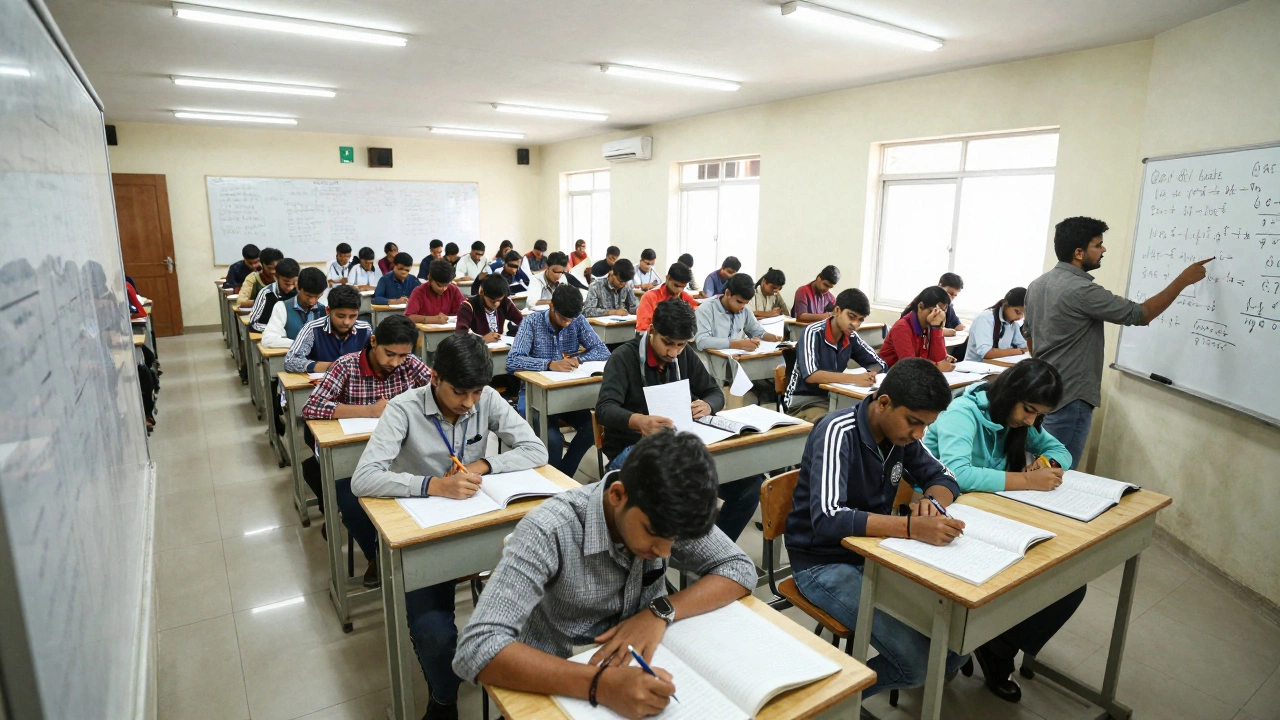
If you prefer to live at home, joining a reputable local coaching center in your city is a strong alternative. Cities like Delhi, Mumbai, Bangalore, and Hyderabad have excellent local institutes that rival Kota-based ones in quality. The benefit here is the ability to maintain a healthier work-life balance. You can sleep better, eat home-cooked meals, and spend time with family, which contributes to mental stability.
Local centers often have smaller batch sizes compared to the giants in Kota. This allows for more personalized interaction with teachers. You can ask doubts immediately after class without waiting for a scheduled doubt session. However, the downside is that you must possess high levels of self-discipline. Without the strict schedule of a hostel, it is easy to procrastinate or get distracted by social media and friends.
Online Learning and Self-Study: The Flexible Route
The rise of digital platforms has made online JEE preparation a viable and often superior option for many. Platforms like Unacademy, Physics Wallah, and Vedantu offer access to top educators from across India without the geographical constraints. You can learn from the same teacher who teaches in a premium Kota batch, but at a fraction of the cost.
Self-study is not just about watching videos; it is about active engagement. Successful self-learners treat their home like a workplace. They create a strict timetable, take regular mock tests, and analyze their performance rigorously. The key resources for self-study include NCERT books for basics, followed by advanced texts like HC Verma for Physics, OP Tandon for Chemistry, and RD Sharma or Cengage for Mathematics.
This route requires exceptional maturity. If you struggle with motivation or easily get distracted, self-study can become a trap. However, if you are disciplined, it offers the highest return on investment because you control the pace and depth of your learning.
Comparing Top Options: What Fits You?
| Feature | Residential Institutes (e.g., Allen) | Local City Centers | Online/Self-Study |
|---|---|---|---|
| Cost | High (₹3-5 Lakhs+ including hostel) | Moderate (₹1-2 Lakhs) | Low to Moderate (₹20k-1 Lakh) |
| Structure | Rigid, High Pressure | Moderate, Balanced | Flexible, Self-Directed |
| Peer Group | Large, Highly Competitive | Moderate, Local Peers | Virtual, Community-Based |
| Doubt Resolution | Scheduled Sessions | Immediate Access | Forum/Live Chat |
| Best For | Students needing discipline | Students wanting balance | Self-motivated learners |

Key Factors to Evaluate Before Choosing
Don’t just go by the brand name. Visit the institute if possible. Talk to current students, not just the counselors. Ask them specific questions: How responsive are the teachers? Is the study material updated? How are the mock tests conducted? Look for institutes that emphasize concept-building over shortcut tricks. Shortcuts might help in JEE Main, but they will fail you in JEE Advanced.
Consider the faculty’s experience. A senior teacher with deep subject knowledge is often more valuable than a young, energetic teacher who lacks depth. Also, check the track record of the specific branch you are joining. A national brand might have varying quality across different cities.
Building Your Own Strategy
Regardless of the school you choose, your personal strategy matters most. Start early. Consistency beats intensity. Studying 6 hours daily for two years is far more effective than studying 14 hours for three months. Focus on understanding the 'why' behind every formula. Practice previous year questions (PYQs) religiously. Analyze every mistake you make in mock tests. Keep a error log to review weak areas regularly.
Remember, the goal is not just to clear JEE, but to build a strong foundation in engineering principles. The skills you develop during this preparation-problem-solving, resilience, and time management-will serve you well beyond the exam hall.
Is Kota really necessary for JEE preparation?
No, Kota is not strictly necessary. While it has many top institutes, similar quality education is available in major cities and through online platforms. Success depends more on your consistency and effort than your location.
What is the average cost of JEE coaching?
The cost varies widely. Residential programs in Kota can range from ₹3 to ₹5 lakhs or more. Local city centers typically charge between ₹1 to ₹2 lakhs. Online courses are significantly cheaper, ranging from ₹20,000 to ₹1 lakh depending on the platform and features.
Can I prepare for JEE Advanced without coaching?
Yes, many students have cleared JEE Advanced through self-study. It requires extreme discipline, access to good study materials (like NCERT, HC Verma, and previous year papers), and regular self-assessment via mock tests.
Which subjects should I focus on first?
It is advisable to start with Mathematics and Physics as they form the base for many engineering concepts. Chemistry can be picked up later as it involves more memorization and factual data, though physical chemistry requires conceptual understanding.
How important are mock tests?
Mock tests are crucial. They simulate exam conditions, help improve time management, and identify weak areas. Taking regular full-syllabus mocks and analyzing them thoroughly is one of the most effective ways to boost your score.