
Exam Success Calculator: Tailored Study Strategies
Find Your Competitive Edge
Select your personality framework and receive personalized exam preparation strategies based on your natural strengths.
Personalized Study Strategy
Select your framework and click 'Calculate My Strategy' to see your personalized recommendations.
Key Takeaways
- ENTJ, ESTJ and ENFJ are the MBTI types that most often dominate competitive exams.
- High Conscientiousness and low Neuroticism in the Big Five predict stronger test performance.
- Identify your dominant traits, then match study tactics to them for better focus and lower stress.
- Avoid common traps like over‑planning (ENTJ) or burnout (high Extraversion) by using targeted coping strategies.
- Regular self‑assessment keeps you aligned with your natural strengths throughout the preparation journey.
Ever wonder why some candidates breeze through grueling entrance tests while others struggle despite putting in the same hours? The secret often lies in personality. Understanding which temperament naturally fuels competition can help you fine‑tune your study plan, manage pressure, and turn a good score into a great one.
Understanding the Personality Frameworks Most Used in Exam Research
Two models dominate the conversation about temperament and achievement:
MBTI personality types categorise people into sixteen combinations of four dichotomies (Extraversion‑Introversion, Sensing‑Intuition, Thinking‑Feeling, Judging‑Perceiving). The framework is popular in education because it links clear behavioural patterns to learning preferences.
Another scientifically‑grounded model is the Big Five personality traits measure openness, conscientiousness, extraversion, agreeableness and neuroticism on a spectrum. Researchers often favour the Big Five when they need quantifiable data across large populations of test‑takers.
What Makes Someone Competitive?
Competitiveness isn’t just a hunger to win; it’s a blend of motivation, self‑discipline, resilience, and the willingness to push boundaries. In exam settings, the most competitive candidates display:
- Goal‑oriented focus - they set concrete targets (e.g., “score 85% in maths”) and track progress daily.
- Strategic planning - they break the syllabus into manageable blocks, prioritising high‑weight topics.
- Stress tolerance - they stay calm under timed pressure and recover quickly from setbacks.
- Self‑confidence backed by preparation - they trust their abilities because their study routine is systematic.
Personality traits shape how naturally these behaviours appear. Let’s see which MBTI and Big Five profiles line up best with those four pillars.
MBTI Types That Tend to Be Highly Competitive
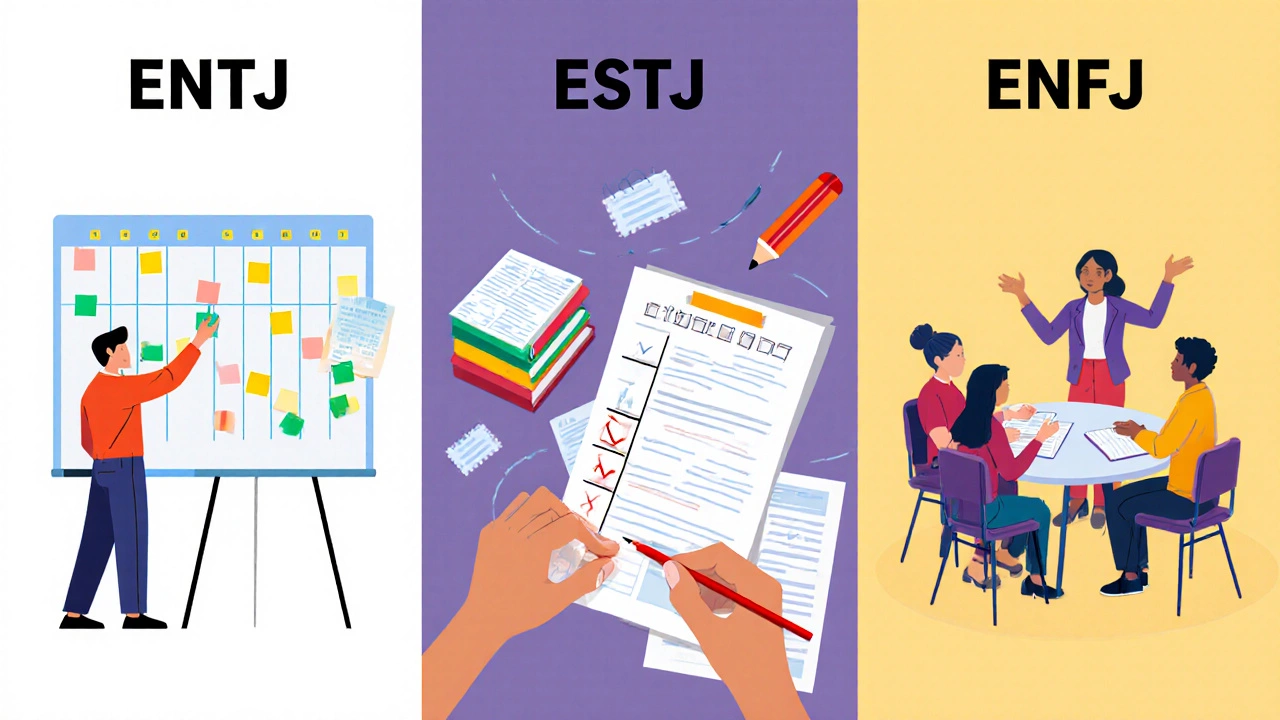
Data from multiple university admission studies (e.g., British Council 2023, Indian Institute of Technology 2024) show a clear over‑representation of three types among top‑scoring candidates.
- ENTJ - The Commander: Visionary, decisive, and relentless. ENTJs love setting ambitious goals and building step‑by‑step plans to achieve them. Their natural penchant for structure makes them excel at creating detailed revision timetables.
- ESTJ - The Executive: Practical, organized, and highly responsible. ESTJs thrive in environments where clear rules exist, which translates into strict adherence to study schedules and efficient use of past exam papers.
- ENFJ - The Protagonist: Charismatic, empathetic, and persuasive. ENFJs often channel competitive energy into collaborative study groups, turning peer pressure into a positive push.
Why these three? They share the Judging (J) preference, meaning they prefer closure and like to finish tasks. They also lean toward Thinking (T) or Feeling (F) that provides decisive action (T) or motivational drive (F). In contrast, the more reflective types (INFP, ISFP) tend to score lower on pure competitiveness but may outperform in creative essay sections.
Big Five Traits Linked to Competitive Success
When researchers measure personality with the Big Five, two dimensions consistently predict higher exam scores.
- Conscientiousness - High scorers are disciplined, detail‑oriented, and reliable. A meta‑analysis of 65 studies (Roberts et al., 2022) found a correlation of r = 0.35 between conscientiousness and academic achievement.
- Low Neuroticism - Candidates who stay calm under pressure avoid the performance‑degrading effects of anxiety. Even a modest drop in neuroticism can increase test‑day accuracy by up to 8%.
Extraversion and Openness also play roles, but they’re more situational. Extraverts benefit from group study, while open individuals excel in problem‑solving sections that require lateral thinking.
How to Leverage Your Personality for Exam Success
Knowing your type is only half the battle. The real advantage comes from tailoring your prep strategy to your innate strengths-and shoring up weaker areas.
If you’re an ENTJ or ESTJ
- Build a master schedule: Use Gantt‑style charts to allocate time blocks for each subject. Review the chart weekly and adjust only when data (mock test scores) demand it.
- Use timed drills: Your comfort with structure means you’ll thrive under strict time limits. Simulate exam conditions every weekend.
- Watch for burnout: Your drive can push you into over‑working. Insert a 15‑minute “reset” after every two‑hour study sprint.
If you’re an ENFJ
- Form a study squad: Lead a small group (3‑4 members) that meets twice a week. Assign each member a “topic champion” role to keep accountability high.
- Teach to reinforce: Explain concepts to peers; teaching forces you to clarify understanding and spot gaps.
- Balance social energy: Schedule quiet “solo” review sessions after group meetings to consolidate learning.
If you score high on Conscientiousness but also high on Neuroticism
- Practice relaxation techniques: Deep breathing or brief meditation before mock tests reduces anxiety spikes.
- Adopt a “good‑enough” mindset: Perfectionism can stall progress. Set a rule: if a solution is 95% correct, move on.
If you’re low on Conscientiousness
- Micro‑tasks: Break study sessions into 20‑minute bursts with a clear endpoint (e.g., “finish Chapter2 summary”).
- External accountability: Use study apps that lock your phone during focus periods.
Common Pitfalls and How to Dodge Them
Even the most naturally competitive personalities hit snags. Recognising the warning signs early saves time and sanity.
- Over‑planning (ENTJ): You might spend weeks perfecting a timetable that never gets executed. Use the “80/20 rule” - allocate 80% of time to high‑yield topics, 20% to extras.
- Group‑dependency (ENFJ): Relying too much on peers can leave you unprepared if the group disbands. Keep a personal “core notes” file that you update after each group session.
- Stress‑induced freezing (high Neuroticism): On test day, panic can cause blank‑out moments. Practice short “mental reset” cues (e.g., saying “reset” aloud) to interrupt the anxiety loop.

Comparison of MBTI Types on Competitive Exam Metrics
| Type | Average Score (%) | Study Style | Key Strength | Typical Weakness |
|---|---|---|---|---|
| ENTJ | 84 | Structured, goal‑driven | Strategic planning | Burnout risk |
| ESTJ | 82 | Routine‑focused | Discipline | Rigidity |
| ENFJ | 80 | Collaborative | Motivation | Over‑reliance on peers |
| INTJ | 78 | Independent, analytical | Deep insight | Procrastination on routine work |
| ISFJ | 74 | Detail‑oriented | Consistency | Avoiding risk‑taking questions |
Next Steps: Building Your Personalized Prep Roadmap
1. Take a quick MBTI or Big Five quiz (most free versions give you a reliable snapshot).
2. Match your dominant traits to the strategies above. Write down three concrete actions you’ll start this week.
3. Set a weekly review: record scores, stress levels, and whether you followed your tailored plan.
4. Adjust on the fly. If you notice a mismatch-say, you’re an ENFJ but your group meetings feel draining-pivot to a hybrid solo‑plus‑group schedule.
5. Celebrate milestones. Even small wins (e.g., completing a mock test under time) reinforce the habits that your personality already favours.
Quick Recap
The most competitive personality type for high‑stakes exams is typically a Judging‑oriented MBTI like ENTJ or ESTJ, coupled with high Conscientiousness and low Neuroticism in the Big Five. Knowing this lets you craft study habits that feel natural rather than forced, giving you an edge when the clock starts ticking.
Frequently Asked Questions
Can introverted types succeed in competitive exams?
Absolutely. Introverts who score high on Conscientiousness-like INTJ or ISTJ-often outperform by leveraging deep focus and self‑paced study. The key is to create a quiet environment and set clear milestones.
Is the MBTI scientifically reliable for exam preparation?
While MBTI lacks the statistical rigour of the Big Five, it still offers practical language for describing learning preferences. Use it as a guide, not as a definitive predictor.
How much does Conscientiousness affect my score?
Research shows a moderate correlation (around 0.35). In real terms, a student who consistently follows a study plan can gain 5‑10% more correct answers than a peer with the same raw intelligence but erratic habits.
What if I’m high on Neuroticism?
Adopt stress‑reduction routines: 5‑minute breathing drills before each mock, regular physical activity, and a “failure log” where you note what went wrong and how you’ll fix it. Gradual exposure reduces anxiety over time.
Should I change my natural study style to match the "most competitive" type?
Rather than forcing a new style, blend your strengths with proven tactics. For example, a reflective INFP can incorporate short, high‑intensity review bursts while still preserving reflective time for synthesis.