
Career Path Comparison Tool (2026)
Compare the top high-demand career paths based on time to hire, salary potential, and difficulty level.
You don't need a four-year degree to land a good job anymore. In fact, if you're staring at a stack of student loans and wondering how to pivot your career, that old advice might actually be holding you back. The real question isn't just which course is "best"-because that depends entirely on your goals-but which course gives you the fastest route to a paycheck.
In 2026, the job market has shifted dramatically. Employers are less interested in where you went to school and more focused on what you can do right now. They want proof of skill. This means certifications, portfolios, and demonstrable competence have overtaken traditional diplomas in many sectors. If you choose the right path, you can go from zero experience to employed in six months or less.
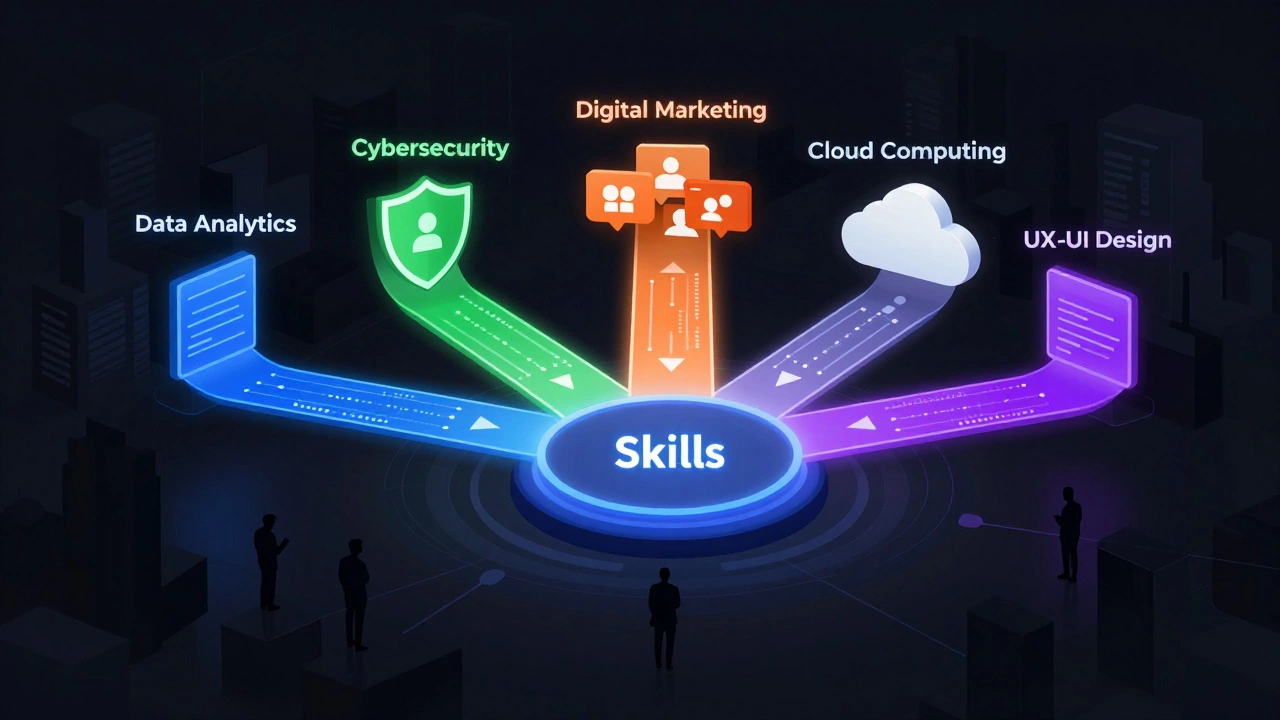
Quick Summary: Top Paths to Employment
- Data Analytics: High demand across all industries; requires SQL, Python, and visualization tools like Tableau.
- Cybersecurity: Critical shortage of workers; entry-level roles often require CompTIA Security+ or similar certs.
- Digital Marketing: Low barrier to entry; success depends on building a portfolio of campaigns and understanding SEO/SEM.
- Cloud Computing: Tech infrastructure backbone; AWS or Azure certifications are gold standards for hiring managers.
- UX/UI Design: Creative but technical; requires a strong portfolio showing user research and design thinking.
The Reality Check: No Course Guarantees a Job
Let's be honest for a second. There is no magic button. Enrolling in a course doesn't mean a recruiter will call you tomorrow. However, certain fields have such a high volume of open positions that if you have the basic skills, you will likely find work quickly. The key is matching the course to the market gap.
Many people fall into the trap of choosing a course because it sounds cool or trendy. That’s a mistake. You need to look at labor statistics. For example, while AI development is booming, entry-level AI engineering roles often still require advanced degrees. But Data Analysis is a field that sits between raw data and business decisions, requiring practical skills in querying databases and visualizing trends. Every company, from hospitals to retail chains, needs someone to make sense of their data. That makes it one of the most accessible high-paying entry points today.
Top 5 High-Demand Skills for Quick Hiring
To help you decide, let’s break down the five most reliable paths to employment in 2026. These aren’t just buzzwords; they are sectors with documented talent shortages.
1. Data Analytics
Data analysts are the translators of the digital world. Businesses collect massive amounts of information, but without an analyst, that data is useless noise. To get hired here, you don’t need to be a mathematician. You need to know how to ask questions of data.
The essential toolkit includes:
- SQL (Structured Query Language): Used to pull data from databases. This is non-negotiable.
- Excel/Google Sheets: Advanced functions like VLOOKUP and Pivot Tables are still widely used.
- Visualization Tools: Tableau or Power BI. You need to show stakeholders what the data means visually.
- Python or R: Helpful for deeper analysis, though not always required for junior roles.
A typical bootcamp or structured online course in this area takes about three to six months. Once you build a portfolio of three to five projects analyzing real-world datasets, you are ready to apply.
2. Cybersecurity
If you prefer logic and problem-solving over creativity, cybersecurity is a goldmine. With cyberattacks increasing in frequency and sophistication, companies are desperate for people who can protect their systems. The barrier to entry is slightly higher than marketing, but the pay is significantly better.
You should start with foundational certifications rather than a full degree. The CompTIA Security+ is an industry-recognized certification that validates baseline skills necessary to perform core security functions and pursue an IT security career. Many employers accept this as proof of competency for entry-level SOC (Security Operations Center) analyst roles. Follow this up with hands-on labs where you simulate defending networks against attacks.
3. Digital Marketing
This is the most flexible option. If you’re creative and comfortable with social media, this path allows you to freelance while looking for full-time work. Digital marketing covers everything from Search Engine Optimization (SEO) to paid advertising (PPC) and email campaigns.
The catch? It’s competitive. To stand out, you can’t just take a course; you must execute. Start a blog, run ads for a local friend’s business, or manage social media for a nonprofit. When you interview, you show results: "I increased traffic by 40%" speaks louder than any certificate.
4. Cloud Computing
Almost every modern app runs on the cloud. Companies are moving away from physical servers to platforms like Amazon Web Services (AWS), Microsoft Azure, and Google Cloud Platform (GCP). They need engineers to manage these environments.
An entry-level role might be a Cloud Support Associate. Getting certified in AWS Certified Cloud Practitioner or Azure Fundamentals shows employers you understand the ecosystem. Combine this with basic networking knowledge, and you become highly employable.
5. UX/UI Design
User Experience (UX) and User Interface (UI) design focus on making products easy and pleasant to use. It’s a blend of psychology, design, and technology. Unlike coding, you don’t need to write software, but you need to understand how users interact with it.
Your primary asset here is your portfolio. A course should teach you the design process: empathy mapping, wireframing, prototyping, and usability testing. Tools like Figma are the industry standard. If you can demonstrate that you’ve improved a product’s usability through testing, you have a job.
| Field | Time to Job Ready | Key Skill/Certification | Entry-Level Salary Range (US) | Difficulty Level |
|---|---|---|---|---|
| Data Analytics | 3-6 Months | SQL, Tableau, Python | $55k - $75k | Moderate |
| Cybersecurity | 6-9 Months | CompTIA Security+, Network+ | $60k - $80k | Hard |
| Digital Marketing | 1-3 Months | Google Ads, SEO, Analytics | $45k - $65k | Easy-Moderate |
| Cloud Computing | 6-12 Months | AWS/Azure Certifications | $70k - $90k | Hard |
| UX/UI Design | 4-8 Months | Figma, Portfolio Projects | $50k - $70k | Moderate |
How to Choose the Right Course for You
Not all online courses are created equal. Some are well-structured learning journeys; others are just recorded lectures with no support. Here is how to filter out the bad ones.
- Check for Project-Based Learning: Avoid courses that only offer multiple-choice quizzes. You learn by doing. Look for syllabi that include capstone projects where you solve a real business problem.
- Look for Industry Recognition: Does the course partner with companies like Google, IBM, or Microsoft? Their certificates carry weight because employers trust the curriculum quality.
- Verify Instructor Credentials: Is the teacher a professor who hasn’t worked in the industry since 1990? Or are they a current practitioner? You want insights from someone who is currently hiring or working in the field.
- Community and Support: Learning alone is hard. Platforms that offer peer review, mentorship, or active community forums increase your completion rate significantly.
Building Your Proof of Work
Once you finish the course, the real work begins. You need to bridge the gap between "student" and "employee." This is done through your portfolio and resume.
For technical roles like data analytics or coding, host your code on GitHub. Write clear README files explaining what the project does and why you built it. For design roles, use Behance or Dribbble to showcase your process, not just the final image. Explain the problem you solved and the impact it had.
Don’t ignore soft skills. Communication is critical. Can you explain complex technical issues to non-technical stakeholders? Practice this. Record yourself presenting a project. Get feedback. This preparation will make you stand out in interviews where candidates often freeze when asked to describe their work.

Avoiding Common Pitfalls
Many learners burn out or waste money. Here are the traps to avoid:
- Certificate Hoarding: Having ten certificates in different areas looks suspicious. It suggests you lack depth. Pick one path and go deep.
- Igoring Networking: Applying online is the hardest way to get a job. Use LinkedIn to connect with alumni from your course. Ask for informational interviews, not jobs. Build relationships first.
- Underestimating Time Commitment: Part-time study requires discipline. Set aside specific hours each week. Treat it like a job. If you say you’ll study 10 hours a week, stick to it.
Next Steps: Your Action Plan
Ready to start? Here is your checklist for the next 30 days:
- Self-Assessment: Identify your strengths. Do you like numbers, writing, or visual design?
- Market Research: Look at job postings for roles that interest you. Note the top three required skills.
- Select a Course: Choose a program that covers those specific skills and includes a final project.
- Create a Schedule: Block out time in your calendar for study. Consistency beats intensity.
- Start Building: Even before finishing the course, start small projects. Share them on social media to begin building your professional brand.
The best course is the one you finish and apply. Don’t wait for perfection. Start learning, start building, and start applying. The market rewards action.
Can I get a job with just an online certificate?
Yes, in many tech and digital fields, a certificate combined with a strong portfolio is sufficient for entry-level roles. Employers prioritize demonstrated skills over formal degrees in sectors like data analytics, web development, and digital marketing. However, some corporate or government roles may still require a bachelor's degree.
How long does it take to get hired after completing a course?
Typically, it takes 3 to 6 months of active job searching after completing a course. This timeline depends on the field, your location, and the strength of your portfolio. Fields with high demand like cybersecurity and cloud computing may yield offers faster, while creative fields like UX design might take longer due to subjective hiring processes.
Are free online courses enough to get a job?
Free courses can provide foundational knowledge, but they often lack structure, mentorship, and recognized credentials. While you can learn skills for free, paid bootcamps or professional certificates often provide the network, career services, and verified proof of competency that hiring managers look for. Consider free resources as supplements, not replacements, for a comprehensive career-changing education.
Which skill is in highest demand in 2026?
Data literacy and AI-related skills are among the highest demands. Specifically, the ability to analyze data using SQL and Python, and to implement secure cloud infrastructures, remains critically short-staffed. Additionally, cybersecurity expertise continues to grow as threats evolve. Soft skills like adaptability and communication are also increasingly valued alongside technical abilities.
Do I need prior experience to enroll in these courses?
Most entry-level online courses in tech and digital marketing are designed for beginners with no prior experience. They start with fundamentals and build up to complex projects. However, some advanced specializations may require prerequisite knowledge. Always check the course prerequisites before enrolling to ensure it matches your current skill level.