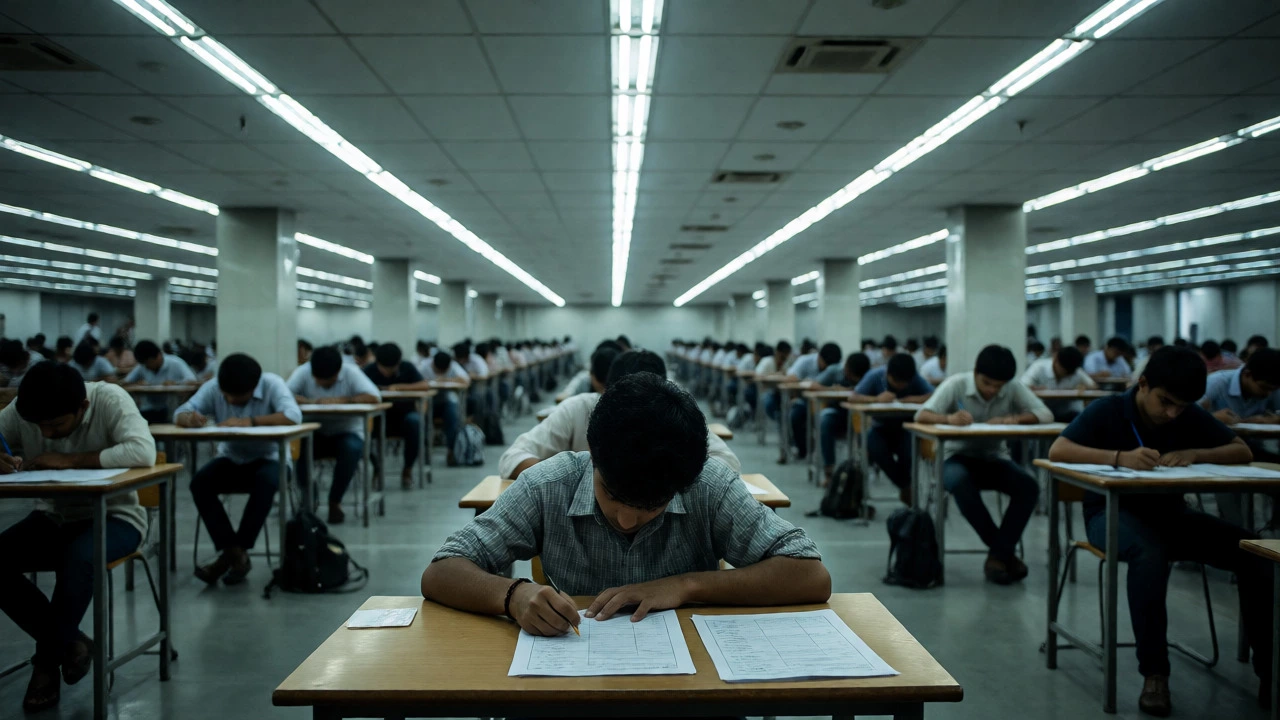
JEE Advanced Paper Difficulty & Strategy Simulator
IIT Bombay Analysis
Last Hosted: 2023Key Characteristics
Questions align with NCERT but twist concepts. Multi-concept problems linking Physics and Math. Rewards clarity over rote memorization.
Recommended Strategy
- Focus on deep conceptual understanding of fundamentals.
- Practice multi-topic integration questions.
- Avoid obscure topics outside the syllabus; stick to core principles.
You spent three years grinding through calculus and organic chemistry, only to find out that your score depends partly on which Indian Institute of Technology decided to set the questions this year. It’s not just about how much you studied; it’s about luck in the draw. The JEE Advanced is administered by a rotating consortium of seven IITs, and each one brings a distinct flavor to the exam. Some are notorious for tricky logic puzzles, while others stick to standard textbook problems. If you’ve ever wondered which IIT actually made the test easier-or harder-you’re asking the right question.
The Myth of the "Easy" Paper
First, let’s clear up a misconception. There is no official "easy" or "hard" tag attached to an exam. The Joint Admission Board (JAB) uses statistical normalization to account for these variations. But students don’t care about normalization formulas when they are sweating in the exam hall. They care about time management and accuracy. Historically, certain IITs have developed reputations based on student feedback, coaching institute analyses, and cut-off trends.
When we look at data from the last decade, a pattern emerges. IIT Bombay and IIT Delhi often produce papers that are conceptually deep but fair. In contrast, IIT Guwahati and IIT Hyderabad have occasionally released sets that felt disjointed or unexpectedly lengthy. Understanding who sets the paper helps you adjust your strategy. Are you preparing for a conceptual marathon or a speed test?
IIT Bombay: The Benchmark of Balance
IIT Bombay is widely considered the gold standard for setting balanced papers. When they take the lead, as they did in 2018 and 2023, the consensus among top rankers is that the paper was moderate. Not easy, but predictable. Their questions usually align closely with NCERT concepts but twist them slightly to test application skills. You won’t find obscure topics that aren’t in the syllabus. Instead, you’ll face multi-concept problems that require you to link Physics with Mathematics, for example.
Why do students perceive this as "easier"? Because it rewards clarity. If you understand the fundamentals, you can solve the problem. There are fewer traps designed specifically to trick you into choosing the wrong option. For a student aiming for a high percentile, IIT Bombay’s style allows for better score differentiation without punishing those who know their stuff.
IIT Delhi: Conceptual Depth Over Calculation
Next up is IIT Delhi, which took charge in 2024 and previously in 2016. Their approach is different. They tend to minimize heavy calculations and maximize logical reasoning. This doesn’t mean the paper is easy. In fact, many students found the 2024 paper challenging because the questions were novel.
However, if you are good at thinking on your feet, IIT Delhi’s papers might feel less exhausting than calculation-heavy ones. The "difficulty" here is mental fatigue rather than arithmetic endurance. Students who prefer rote memorization often struggle, while those who enjoy puzzle-solving thrive. So, is it easier? Only if you hate long sums.
IIT Madras: The Surprise Factor
IIT Madras has a reputation for unpredictability. They hosted the exam in 2022 and 2017. In 2022, the Chemistry section, in particular, caught many off guard with its emphasis on statement-based questions and assertion-reasoning types that required precise knowledge of exceptions.
While the overall difficulty was rated moderate-to-difficult, the structure changed significantly. They introduced more single-correct options and reduced the number of multiple-correct questions compared to previous years. This shift favored students who were confident in their facts. If you guessed, you lost marks. If you knew, you gained. This binary nature makes it feel harder for some, but straightforward for others.
IIT Guwahati and IIT Kanpur: The Tougher Contenders
Let’s address the elephant in the room. Papers set by IIT Guwahati (2021) and IIT Kanpur (2020) are frequently cited in forums as being among the tougher ones of recent times. Why? Length. Both exams suffered from criticism regarding the sheer volume of text and complex problem statements. Students reported running out of time not because they couldn’t solve the problems, but because reading and decoding them took too long.
In 2021, the Mathematics section was particularly grueling. It wasn’t necessarily that the concepts were beyond the syllabus, but the integration of multiple steps made each question a mini-project. Similarly, IIT Kanpur’s 2020 paper faced backlash for ambiguous questions in Physics. These instances highlight that "difficulty" isn’t just about IQ-it’s about stamina and clarity of instruction.
Comparative Analysis: Who Was Easiest?
To make sense of this, we need to look at average scores and top percentiles. While exact raw averages vary, the relative performance across years gives us clues. Generally, years with higher average scores suggest a perceived "easier" paper, assuming the candidate pool remained consistent.
| Year | Organizing IIT | Student Perception | Key Characteristic |
|---|---|---|---|
| 2025 | IIT Roorkee | Moderate | Balanced sections, standard format |
| 2024 | IIT Delhi | Moderate-Difficult | Novel concepts, low calculation |
| 2023 | IIT Bombay | Moderate | Conceptual depth, fair marking |
| 2022 | IIT Madras | Moderate-Difficult | Statement-heavy, factual precision |
| 2021 | IIT Guwahati | Difficult | Lengthy questions, time pressure |
| 2020 | IIT Kanpur | Difficult | Ambiguity issues, complex math |
Based on this table and community sentiment, IIT Bombay consistently produces papers that are deemed most manageable for well-prepared students. Their questions respect the syllabus boundaries and reward logical deduction over guesswork. IIT Roorkee, which organized the 2025 exam, also followed a similar trend of maintaining a standard difficulty level, avoiding extreme surprises.

Does "Easier" Mean Higher Cutoffs?
Here is the catch. An easier paper doesn’t help you get into IIT Bombay automatically. In fact, it raises the stakes. When the paper is easier, everyone scores higher. The cutoff for General category admissions jumps dramatically. In years like 2018 (set by IIT Bombay), the competition was fierce because small mistakes cost you thousands of ranks.
Conversely, in a tough year like 2021, the cutoffs dropped. But you needed to be mentally resilient to handle the stress. So, which is better? If you are a fast solver who hates ambiguity, an "easier" paper like IIT Bombay’s is preferable. If you are a slow, methodical thinker who panics under time pressure, a slightly tougher but clearer paper might actually suit you better.
Strategic Takeaways for Aspirants
You cannot predict next year’s organizer with 100% certainty until the announcement, but you can prepare for all styles. Here is how:
- Master the Fundamentals: Regardless of who sets the paper, NCERT and standard reference books are non-negotiable. IIT Bombay and IIT Delhi rely heavily on core concepts.
- Practice Time Management: To combat the "lengthy paper" issue seen in IIT Guwahati’s tenure, practice solving full mock tests under strict time limits. Learn to skip questions quickly.
- Enhance Reading Speed: Modern JEE papers are becoming more verbose. Practice extracting key data from long problem statements without losing focus.
- Vary Your Mock Tests: Don’t just stick to one coaching institute’s pattern. Solve past papers from all IITs. Notice how IIT Madras asks assertion-reasons versus how IIT Kanpur structures numerical values.
The Future of Paper Setting
The JAB is aware of the complaints regarding inconsistency. Recent guidelines have encouraged organizing IITs to maintain a standard deviation in difficulty levels. The goal is to reduce the lottery effect. However, human error and differing academic philosophies will always exist. IITs are research institutions first, exam bodies second. Their professors value innovation, which sometimes translates to unconventional questions.
For the 2026 cycle, keep an eye on the announcements. If IIT Kharagpur or IIT Indore takes the lead, expect a different vibe. Historically, newer IITs have tried to prove themselves by setting rigorous standards, sometimes erring on the side of caution (making it harder).
Which IIT set the easiest JEE Advanced paper in the last 5 years?
Generally, IIT Bombay (2023) and IIT Roorkee (2025) are perceived as having set the most balanced and moderately difficult papers. Students often find their questions fair and aligned with standard preparation strategies, leading to higher average scores compared to years set by IIT Guwahati or IIT Kanpur.
Does an easier JEE Advanced paper result in lower cutoffs?
No, it usually results in higher cutoffs. When a paper is easier, more students score high marks, increasing the competition for limited seats. Therefore, the percentile required to secure admission rises significantly in years with perceived easier papers.
How does IIT Delhi's paper style differ from IIT Bombay's?
IIT Bombay tends to focus on multi-concept application within standard frameworks, rewarding thorough understanding. IIT Delhi often introduces novel problem structures with minimal calculation, testing logical reasoning and adaptability. IIT Bombay’s papers are generally more predictable, while IIT Delhi’s can be surprising.
Why are some JEE Advanced papers criticized as unfair?
Criticism usually stems from ambiguous questions, excessive length leading to time constraints, or topics that stretch the upper limits of the syllabus. Years like 2020 (IIT Kanpur) and 2021 (IIT Guwahati) faced backlash for these reasons, prompting the JAB to refine normalization processes.
Should I change my study plan based on the upcoming organizer?
Not drastically. Your core preparation should remain robust. However, once the organizer is announced, you can tweak your mock test selection to mimic their historical style. If IIT Madras is hosting, practice more statement-based questions. If IIT Bombay is hosting, focus on integrated concept problems.