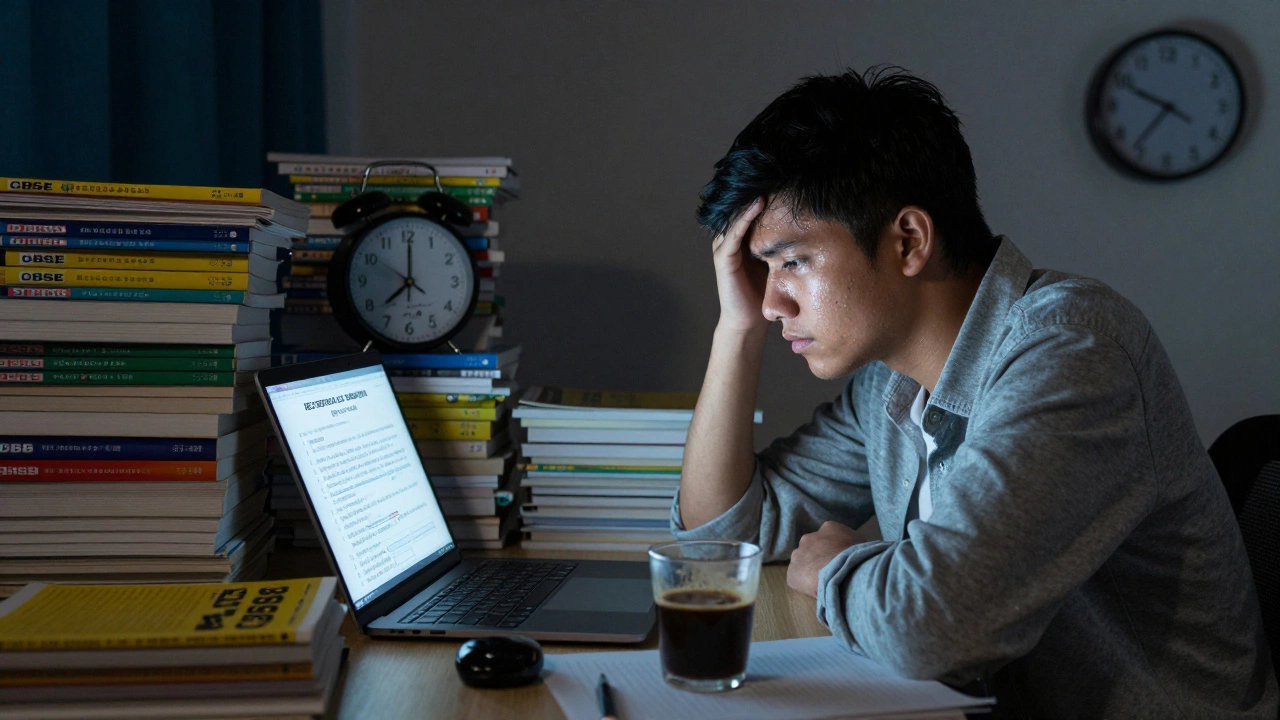
When it comes to school education in India, not all boards are created equal. Parents, students, and teachers often debate which board is the hardest. While there are many state boards and national boards, two stand out for their rigor, depth, and pressure: CBSE and ICSE. But which one is truly tougher? And why does it matter?
What Makes a Board ‘Tough’?
There’s no single way to measure difficulty. Some say it’s about the syllabus. Others point to exam patterns, grading, or the pressure to perform. For students in India, toughness usually means one thing: how much effort it takes to score well. A tough board doesn’t just test memory-it tests understanding, application, and time management.
The two most talked-about boards are CBSE and ICSE. Both are recognized nationwide, but they operate very differently. CBSE is run by the Central Board of Secondary Education, a government body. ICSE, or the Indian Certificate of Secondary Education, is managed by the Council for the Indian School Certificate Examinations (CISCE), a private organization. Their differences go beyond administration-they shape how students learn.
CBSE: The High-Pressure National Standard
CBSE is the most popular board in India, with over 20,000 affiliated schools. It’s the default choice for families who move often, since CBSE schools are everywhere. But popularity doesn’t mean ease.
The CBSE syllabus is streamlined. It’s designed to prepare students for national competitive exams like JEE (for engineering) and NEET (for medicine). That means the content is focused, direct, and heavily weighted toward science and math. Students in Class 10 and 12 face exams that are timed, objective-heavy, and graded strictly. There’s little room for creative answers. If you don’t follow the marking scheme exactly, you lose marks-even if your logic is correct.
What makes CBSE tough isn’t just the content. It’s the volume. A typical CBSE student juggles 5-6 major subjects, each with dense theory, complex numerical problems, and lab work. In Class 12, physics alone can have over 15 chapters, each requiring deep conceptual clarity. The board doesn’t reward long essays. It rewards precision. One wrong formula, one misstep in a derivation, and you lose half the marks.
And then there’s the competition. Millions of CBSE students take the same exams. Your percentile matters more than your raw score. That pressure doesn’t just come from school-it comes from society. If you’re aiming for IITs or AIIMS, CBSE is your only path. And that path is paved with late nights, coaching centers, and relentless practice.
ICSE: The Depth Over Breadth Challenge
ICSE is smaller. Only about 2,000 schools in India follow it. But those schools are often elite, private institutions with high fees. ICSE students are expected to be well-rounded. That’s where the toughness comes in.
ICSE’s syllabus is broader. It includes subjects like environmental science, literature, and computer applications that CBSE treats as electives or skips entirely. In Class 10, a student might study 10 subjects instead of 5 or 6. Each subject has a heavier emphasis on writing, analysis, and critical thinking.
For example, in English Literature, ICSE doesn’t ask you to summarize a poem. You’re expected to analyze its metaphors, historical context, and author’s intent. In History, you don’t just memorize dates-you debate causes and consequences. In Science, you’re asked to design experiments, not just recall formulas.
The exams reflect this. ICSE papers are long. A 3-hour English paper might have 5 essay questions. A 2-hour Physics paper could include 10 numericals plus 5 theory-based explanations. There’s no multiple-choice section. Every answer must be written out. And grading is strict-not just for content, but for structure, grammar, and clarity.
ICSE students often spend more time reading than memorizing. They read novels, journals, and primary sources. They write essays that are 500-800 words long. They’re trained to think, not just recall. That’s exhausting. It’s not about how much you know-it’s about how clearly you can express it.
Comparing the Two: Syllabus, Exams, and Outcomes
| Aspect | CBSE | ICSE |
|---|---|---|
| Number of Subjects (Class 10) | 5-6 core subjects | 8-10 subjects including electives |
| Exam Format | Mostly objective + short answers | Long-form written answers only |
| Focus | Science, Math, Competitive Exam Prep | Language, Critical Thinking, Holistic Learning |
| Grading Rigor | Strict on accuracy, low tolerance for errors | Strict on structure, grammar, and depth |
| Textbook Depth | Concise, exam-oriented | Detailed, includes supplementary reading |
| Best For | Students aiming for JEE, NEET, government exams | Students aiming for liberal arts, international universities |
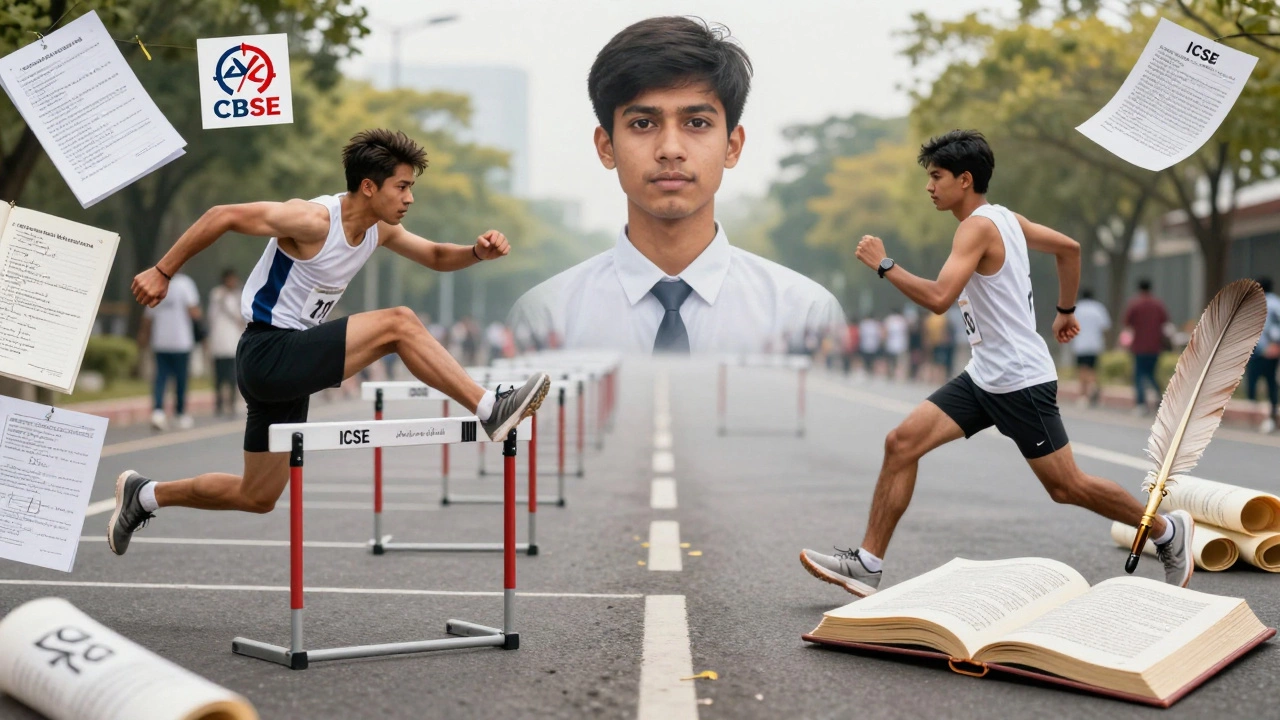
CBSE is like a sprint. You need speed, accuracy, and stamina. ICSE is like a marathon with hurdles. You need endurance, expression, and mental flexibility.
Why This Matters Beyond School
Some argue that neither board is inherently harder-it’s the student’s goals that decide. If you want to become an engineer in India, CBSE gives you the direct path. If you want to study literature at Oxford or philosophy at Harvard, ICSE’s depth gives you an edge.
But here’s the truth: both boards are tough in their own way. CBSE pushes you to master high-stakes technical content under time pressure. ICSE pushes you to think deeply, write clearly, and manage a heavier workload. Neither is easy. Neither is designed for comfort.
Many students who switch from ICSE to CBSE (or vice versa) say the same thing: "I thought my board was hard. Then I tried the other one-and realized I had no idea what hard really meant."
What Do Top Performers Say?
Students who top both boards often come from ICSE backgrounds. Why? Because they’re used to writing long answers, managing multiple subjects, and thinking critically. But the top JEE rankers? Almost all come from CBSE. They’ve trained for years to solve 100+ problems in 3 hours.
There’s no single "toughest" board. It depends on what you’re being tested on. If you’re good at memorizing formulas and solving problems fast, CBSE feels manageable. If you’re good at analyzing texts, writing essays, and handling ambiguity, ICSE might feel more natural.
But here’s what no one tells you: the toughest part isn’t the board. It’s the expectation. In India, your board doesn’t just reflect your learning-it defines your future. That pressure is universal.
Final Thought: It’s Not About the Board, It’s About You
There’s no magic formula. You don’t need to switch boards to succeed. Many ICSE students crack IITs. Many CBSE students become award-winning writers. The board is just the starting point.
What matters is how you use it. If you’re in CBSE, don’t just memorize. Understand the "why" behind every formula. If you’re in ICSE, don’t just write essays. Learn to argue, to question, to connect ideas. The board gives you the structure. You give it meaning.
So, which is tougher? CBSE or ICSE? The answer isn’t on the syllabus. It’s in the effort you put in.
Is CBSE tougher than ICSE for competitive exams like JEE and NEET?
Yes, CBSE is generally considered more aligned with JEE and NEET preparation. Its syllabus closely matches the content and format of these exams, especially in Physics, Chemistry, and Mathematics. CBSE’s emphasis on problem-solving, numerical accuracy, and standardized testing gives students a direct advantage. Most coaching institutes in India design their programs around CBSE’s curriculum.
Does ICSE help in getting into foreign universities?
Yes, ICSE is often preferred by international universities, especially in the UK, US, and Canada. Its focus on English proficiency, critical writing, and broad subject exposure aligns well with liberal arts education systems. Universities appreciate that ICSE students can analyze texts, write research-style essays, and think independently-skills that go beyond rote learning.
Can an ICSE student crack IIT-JEE?
Absolutely. Many ICSE students have topped JEE with top ranks. While the syllabus differs slightly, the core concepts in Physics, Chemistry, and Math are the same. The difference lies in approach: ICSE students may need extra practice with speed and multiple-choice techniques, but their strong conceptual foundation often helps them excel in deeper questions.
Which board has a higher passing percentage?
CBSE typically has a higher passing percentage than ICSE. This is partly because CBSE’s evaluation is more standardized and less subjective. ICSE’s emphasis on detailed written answers and strict grading in subjects like English and History leads to lower overall pass rates, even among high-achieving students.
Is ICSE harder for students who struggle with English?
Yes. ICSE requires strong English skills across all subjects. Literature, grammar, and even science papers demand clear written expression. Students who struggle with English often find ICSE overwhelming, especially in Class 10 and 12, where written responses carry heavy weight. CBSE, with its more objective format, is often easier for students who are stronger in math and science than in language.
If you’re choosing a board, don’t pick based on reputation. Pick based on your strengths. And if you’re already on one, don’t regret it. The toughest boards don’t break students-they reveal them.