
English Study Plan Generator
Select your options and click "Generate My Plan" to see your customized weekly schedule.
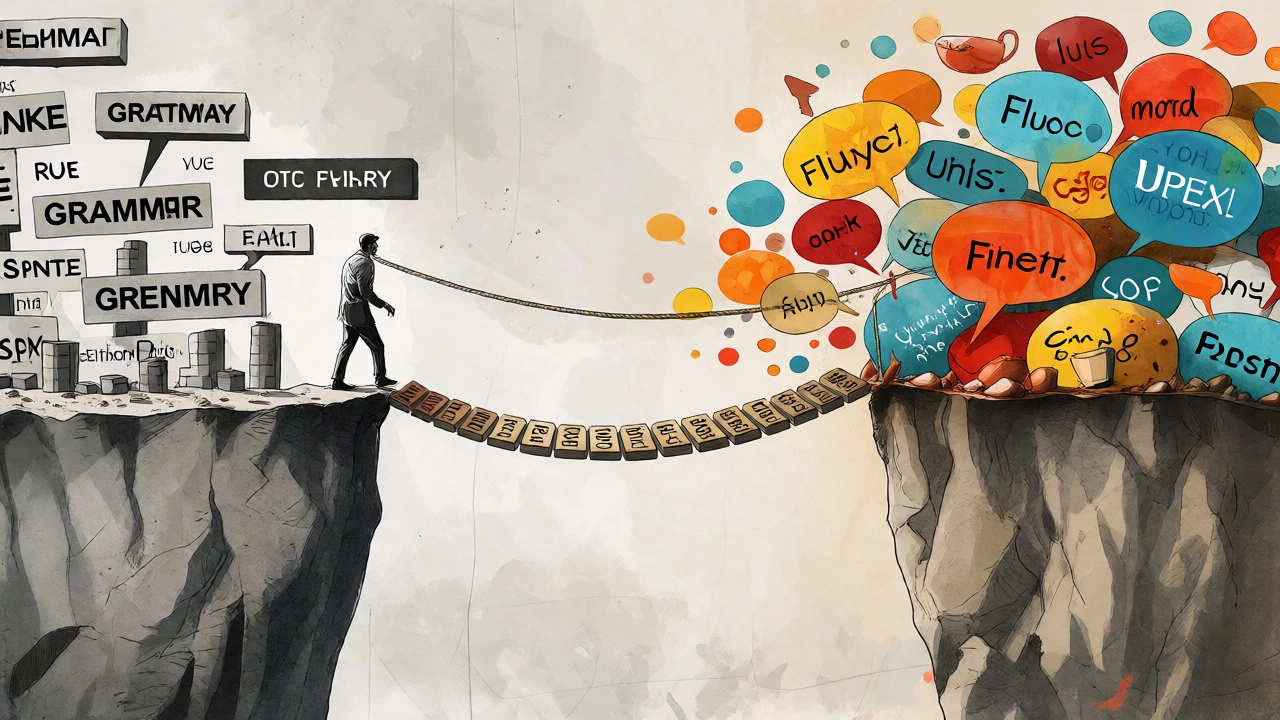
You have been studying English for years. You know the grammar rules. You can read a novel without hitting a dictionary every two pages. Yet, when you try to speak, your brain freezes. Or worse, you sound like a textbook from 1995. This is the classic "intermediate plateau," and it is frustrating because effort no longer equals progress. The problem isn't that you are bad at English; it is that you are studying the wrong things in the wrong way.
Most learners focus on passive knowledge-memorizing word lists or drilling verb tenses. But fluency lives in active usage. To break through, you need to shift your study plan from academic accumulation to functional application. Here is exactly what you should study to actually improve your English, not just accumulate facts about it.
Stop Studying Grammar Rules, Start Studying Patterns
If you still buy books titled "Advanced Grammar," put them down. Unless you are preparing for a linguistics exam, isolated grammar drills rarely translate into fluent speech. Native speakers do not think in subject-verb-object structures while talking; they think in chunks. These chunks are fixed phrases, collocations, and idiomatic expressions that occur together naturally.
Instead of memorizing the rule for the present perfect tense, study how native speakers use it in context. For example, notice how often "I've been meaning to..." appears in casual conversation. It is a specific pattern used to express an intention that hasn't happened yet. When you study these lexical chunks, you stop translating word-for-word and start retrieving whole thoughts instantly. Focus on high-frequency collocations like "make a decision" versus "do a decision." Getting these right makes you sound natural immediately, even if your grammar elsewhere is imperfect.
Immersive Input: Beyond Textbooks
Your ear needs training as much as your mouth does. Standard ESL audio often sounds sterile and slow. To understand real-world English, you must expose yourself to authentic materials where people interrupt each other, mumble, and use slang. This doesn't mean you need to watch complex Shakespearean plays. It means curating content that matches your actual life interests.
If you are a tech professional, listen to podcasts like The Vergecast or Audible Magic. If you love cooking, follow British chefs on YouTube rather than watching educational clips. The key is comprehensible input slightly above your current level. You should understand 70-80% of the content without pausing. If you understand less, it is too hard; if you understand everything, it is too easy. Adjust the difficulty by changing the speaker's accent or the topic's complexity, not by switching to children's cartoons unless you are truly a beginner.

Active Output: The Shadowing Technique
Reading and listening are passive skills. Speaking and writing are active. Most learners neglect active output until they feel "ready," but readiness comes from doing. One of the most effective methods for improving pronunciation and intonation is shadowing. This technique involves listening to a short audio clip and repeating it almost simultaneously, mimicking the rhythm, stress, and melody of the speaker.
| Method | Focus Area | Effort Level | Best For |
|---|---|---|---|
| Shadowing | Pronunciation, Intonation, Speed | High | Muscle memory and accent reduction |
| Journaling | Vocabulary retention, Structure | Medium | Thinking in English without pressure |
| Conversation Clubs | Fluency, Social Confidence | Variable | Overcoming fear of making mistakes |
Start with one-minute clips. Listen once for meaning. Listen again while reading the transcript. Then, speak along with the audio, trying to match the speed exactly. Do this for ten minutes a day. You will feel silly at first, but your mouth muscles will adapt to the physical demands of English phonetics. This bridges the gap between knowing how a word sounds and being able to produce it under pressure.
Vocabulary: Depth Over Breadth
Do you really need to know the word "obfuscate" if you cannot confidently explain why you were late to work? Probably not. Many learners obsess over rare words to sound smart, but communication fails when basic connectors are missing. Prioritize functional vocabulary: transition words, phrasal verbs, and emotional adjectives.
Phrasal verbs are particularly crucial in spoken English. Native speakers prefer "give up" over "surrender" and "find out" over "discover." Create flashcards not just for definitions, but for contexts. Write the sentence where you heard it. Use spaced repetition systems (SRS) like Anki, but ensure you review sentences, not isolated words. Context helps your brain retrieve the word when you need it, rather than forcing you to recall a definition and then translate it back into English.
Cultural Nuance and Pragmatics
Language is culture. In the UK, saying "no" directly can be seen as rude. Instead, you might hear "I'm afraid that won't be possible" or "We'll see." Understanding these pragmatic rules prevents social awkwardness. Study how politeness levels change based on who you are talking to. How do you complain to a waiter versus complaining to your boss?
Read forums like Reddit or comment sections on news articles to see how people argue, joke, and agree informally. Notice the use of understatement, especially in British English. Saying something is "not bad" often means it was excellent. Ignoring these nuances leads to misunderstandings, even if your grammar is perfect. Incorporate cultural studies into your routine by analyzing media characters' motivations and reactions, not just their words.
Creating Your Weekly Study Plan
You don't need hours every day. Consistency beats intensity. Here is a realistic weekly schedule for someone with a full-time job:
- Monday: 15 minutes of shadowing with a podcast episode.
- Tuesday: Read one article related to your hobby. Note three new collocations.
- Wednesday: Write a short summary of Tuesday's article using the new collocations.
- Thursday: Watch a TV show scene without subtitles, then with subtitles. Analyze the humor or conflict.
- Friday: Record yourself speaking for two minutes about your week. Listen back and identify one error to fix.
- Saturday: Have a real conversation with a tutor or language partner. Focus on flow, not perfection.
- Sunday: Review your SRS flashcards for 10 minutes.
This mix covers all four skills-reading, writing, listening, and speaking-without burning you out. The goal is to make English part of your lifestyle, not just another chore on your to-do list.
Frequently Asked Questions
How long does it take to see results?
With consistent daily practice of 30 minutes, you may notice improved confidence and fewer pauses within 4-6 weeks. Significant changes in accent and complex expression usually take 3-6 months of focused effort.
Is it better to learn American or British English?
Choose the variety closest to your goals. If you work with US clients or consume Hollywood media, American English is practical. If you live in Europe or Commonwealth countries, British English is often more relevant. Both are mutually intelligible, so consistency matters more than the specific accent.
Do I need a teacher to improve my speaking?
A teacher provides feedback and correction, which accelerates progress. However, you can improve significantly with self-study techniques like shadowing and recording yourself. A tutor becomes essential when you hit persistent fossilized errors or need accountability.
Why do I forget words during conversations?
This happens because you learned words passively (recognition) rather than actively (production). To fix this, practice using new words in immediate sentences after learning them. Active recall strengthens neural pathways for quick retrieval.
Can movies alone improve my English?
Movies help with listening comprehension and cultural exposure, but they rarely improve speaking ability on their own. Without active output practice, you remain a passive consumer. Combine movie-watching with speaking exercises for balanced progress.