Vocational Path Finder
Find Your Vocational Path
Answer a few questions to discover vocational qualifications that match your interests and background.
What interests you most?
What's your current education level?
What's your main career goal?
Ever wonder why some people land good jobs right after school while others spend years in university just to start at the same point? It often comes down to one thing: vocational qualification. This isn’t about degrees. It’s about real, hands-on skills that employers actually need.
What Exactly Is a Vocational Qualification?
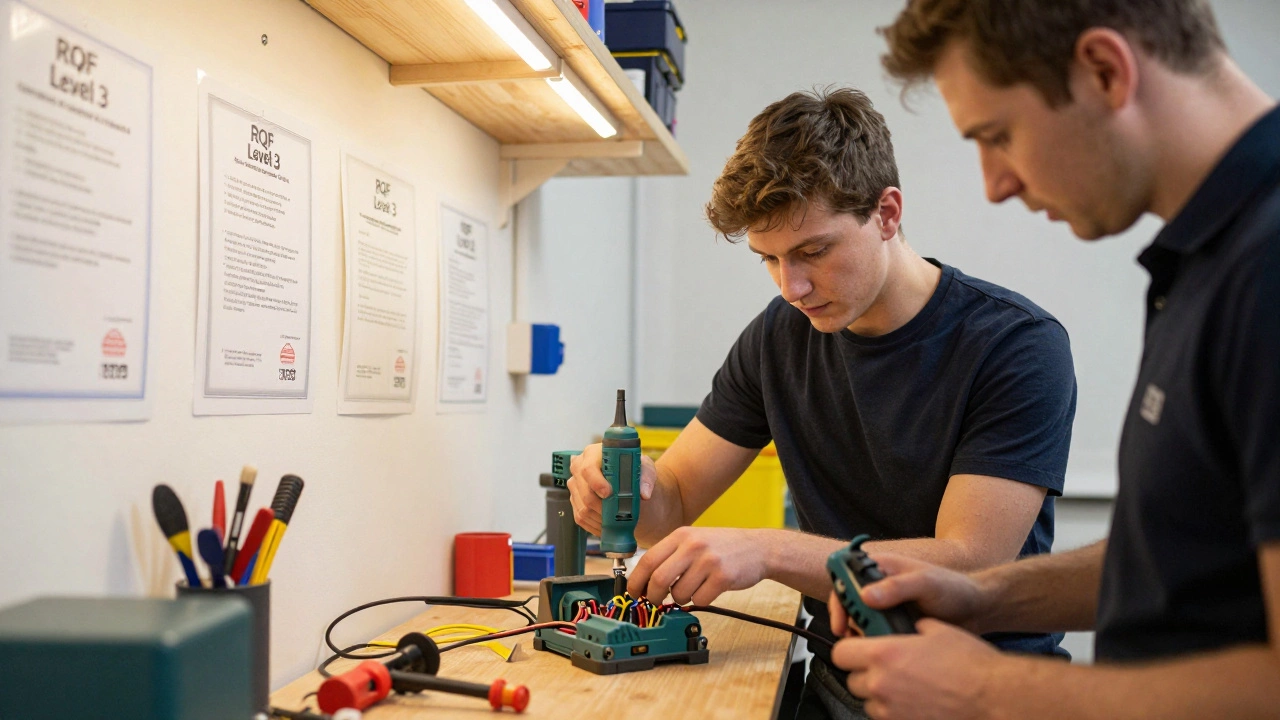
A vocational qualification is a formal certification that proves you’ve learned how to do a specific job. Think electrician, plumber, chef, dental assistant, or warehouse operative. These aren’t theoretical. You don’t just read about them-you practice them until you can do them safely, efficiently, and to industry standards.
In the UK, these qualifications are usually set by awarding bodies like City & Guilds, Pearson BTEC, or NCFE. They’re mapped to the Regulated Qualifications Framework (RQF), which tells you how tough each one is. For example:
- Level 1: Basic skills, like entry-level care work
- Level 2: Equivalent to GCSEs, like a Level 2 Diploma in Hairdressing
- Level 3: Like A-Levels, such as a Level 3 Engineering Technician qualification
- Level 4+: Higher-level skills, like a Foundation Degree in Applied Computing
You earn these through apprenticeships, college courses, or on-the-job training. No essays. No exams on Shakespeare. Just real tasks, real feedback, and real results.
How Is It Different From Academic Education?
Traditional school and university focus on theory, critical thinking, and broad knowledge. A history degree teaches you about revolutions. A vocational qualification teaches you how to fix a boiler.
Here’s the difference in practice:
| Aspect | Vocational Qualification | Academic Qualification |
|---|---|---|
| Focus | Job-specific skills | Theory and analysis |
| Assessment | Practical tasks, portfolios, workplace observations | Exams, essays, research papers |
| Time to complete | 6 months to 2 years | 3-4 years (degree) |
| Cost | Often free or low-cost (especially with apprenticeships) | Tuition fees, often £9,250/year in England |
| Job readiness | Immediate | Usually requires additional training |
One student I spoke to in Bristol switched from a university course in sociology to a Level 3 Beauty Therapy qualification. Six months later, she was working full-time at a salon, earning £18/hour. Her university friends were still paying rent and waiting for internships.
Why Are Vocational Qualifications So Important Now?
The UK job market has changed. Over 70% of new jobs created since 2020 require skilled technical workers, according to the Office for National Statistics. That includes roles in:
- Healthcare support (nursing assistants, phlebotomists)
- Green energy (solar panel installers, heat pump technicians)
- Digital trades (cybersecurity assistants, IT support specialists)
- Skilled trades (plumbers, electricians, carpenters)
These aren’t disappearing jobs. They’re growing. And they’re not waiting for people with PhDs. They’re waiting for people who can turn up, do the work, and fix the problem.
Employers say it plainly: they’d rather hire someone with a Level 3 Electrical Installation qualification than a graduate who’s never held a screwdriver. Why? Because they can start on day one.

Where Can You Get a Vocational Qualification?
You don’t need to go to a fancy university. Here are the most common ways:
- Apprenticeships - You work for an employer, get paid, and study part-time. Levels range from Intermediate (Level 2) to Degree (Level 6). The government covers most of the training cost.
- Further Education Colleges - Nearly every town in the UK has one. They offer full-time and part-time courses in everything from childcare to welding.
- Private Training Providers - Some companies specialize in short, intensive courses. Look for ones approved by Ofqual or the Skills Funding Agency.
- Online Platforms with Practical Components - Some platforms now offer hybrid models: video lessons + in-person lab time. For example, a Level 2 Certificate in Digital Marketing might include real client projects.
Some courses are free if you’re under 24, unemployed, or on certain benefits. Others cost under £500. Compare that to £27,750 for three years of university.
What Jobs Can You Get With One?
Vocational qualifications open doors you might not even know exist. Here are real examples from 2025 job listings in the UK:
- Senior Care Assistant (Level 3 Health & Social Care) - Average salary: £26,000/year. Demand up 34% since 2023.
- Wind Turbine Technician (Level 4 Engineering) - Average salary: £38,000/year. Only 1,200 qualified people in the UK right now.
- Automotive Electrician (Level 3 Vehicle Electrical Systems) - Average salary: £32,000/year. 70% of garages say they can’t find enough trained staff.
- Early Years Educator (Level 3 Childcare) - Average salary: £24,500/year. Over 50,000 new nursery places opened in 2024 alone.
These aren’t low-skill jobs. They’re skilled, respected, and in high demand. Many pay better than graduate entry-level roles.

Common Myths About Vocational Training
Let’s clear up some misunderstandings:
- Myth: It’s only for people who failed school. Truth: Many top performers choose it because it’s faster, cheaper, and more direct. In 2024, 42% of Level 3 apprentices were A*-B grade GCSE students.
- Myth: You can’t go to university later. Truth: Many Level 3 qualifications give you UCAS points. You can do an apprenticeship, then a top-up degree.
- Myth: It’s only for manual jobs. Truth: There are Level 4+ qualifications in cybersecurity, data analysis, and project management. These are tech roles with real pay.
The stigma is fading. The government now promotes apprenticeships as seriously as university. And employers? They’re lining up.
How to Start Your Vocational Journey
If you’re thinking about this path, here’s how to begin:
- Identify your interest. Do you like working with people? Machines? Computers? Food? There’s a qualification for it.
- Check the RQF level. Start at Level 2 if you’re new. Level 3 if you have GCSEs.
- Search for approved providers. Go to gov.uk/find-apprenticeship-training or contact your local college.
- Apply for funding. Ask if you’re eligible for free training or the Advanced Learner Loan.
- Start small. Even a 6-week course can get you an entry-level job. From there, you build.
You don’t need to have it all figured out. You just need to take the first step.
Is a vocational qualification worth it if I want to earn more money?
Yes, absolutely. Many skilled trades and technical roles pay more than graduate entry jobs. For example, a qualified electrician can earn £40,000-£60,000 within five years, often without student debt. A Level 3 Dental Nurse earns £28,000-£35,000, and there’s a national shortage of trained staff. The key is choosing a high-demand field and sticking with it.
Can I get a vocational qualification without going to college?
Yes. Many people earn qualifications through apprenticeships, where you learn on the job. Some employers even pay for your training. Online courses with practical assessments are also growing-like those in digital marketing, IT support, or first aid. You don’t need to sit in a classroom to qualify.
Are vocational qualifications recognised by employers?
Definitely. In fact, many employers prefer them. A 2025 survey by the Confederation of British Industry found that 68% of hiring managers said vocational candidates were better prepared for the job than university graduates. Companies like NHS, Amazon, and Network Rail now hire more apprentices than graduates.
How long does it take to get a vocational qualification?
It depends on the level. A Level 1 course might take 3-6 months. A Level 2 usually takes 1 year. Level 3 typically takes 1-2 years. Apprenticeships can last 1-4 years, but you earn while you learn. The fastest route to a job is often a 6-month Level 2 course followed by on-the-job training.
Can I do a vocational qualification if I’m over 30?
Absolutely. There’s no age limit. In fact, over 30% of apprentices in 2025 were aged 30 or older. Many people switch careers later in life-especially in healthcare, IT, and green energy. The government even offers additional funding for mature learners in high-demand sectors.
If you’re looking for a faster, cheaper, and more direct path to a stable job, vocational qualification isn’t just an option-it’s the smartest one many people never consider.