CBSE Senior Secondary Stream Explorer
Select a stream below to view the core subjects and key topics covered in the CBSE Senior Secondary curriculum (Classes 11-12).
Select a Stream
Choose one of the options above to see detailed subject breakdowns.
Please select a stream to begin exploration.
Did You Know?
The CBSE syllabus is competency-based. Instead of just memorizing definitions, students are tested on applying concepts to real-world scenarios.
Key Tip for Students:
Always check the latest unit-wise weightage in the official PDF. Focus more study time on high-weightage chapters like Algebra or Thermodynamics.
You’ve probably heard the term CBSE thrown around at family gatherings or school admission interviews. But what does it actually mean for your child’s daily life? If you are confused by acronyms like NCERT, KVS, or NIOS, you are not alone. The Central Board of Secondary Education (CBSE) is the primary national-level education board in India, overseeing over 27,000 affiliated schools. It sets the standards for what students learn from Class 1 through Class 12.
Why does this matter? Because the CBSE syllabus isn’t just a list of topics; it’s the blueprint for millions of students’ futures. It dictates which textbooks they buy, how they study for exams, and ultimately, which colleges they can enter. Whether you are a parent trying to decode homework or a student planning your career path, understanding the structure of this syllabus saves you time and stress. Let’s break down exactly what the CBSE syllabus entails, without the academic jargon.
The Core Philosophy: Why CBSE Exists
The Central Board of Secondary Education was established in 1952. Its main job is to provide a uniform educational standard across India. Before CBSE, every state had its own board, making it hard for families who moved frequently due to government jobs or military postings. CBSE solved this by creating a standardized curriculum recognized nationwide and internationally.
The syllabus follows a competency-based approach. This means it’s less about rote memorization-cramming facts for a test-and more about applying knowledge. For example, instead of just asking "Define photosynthesis," a CBSE question might ask you to explain how a plant survives in a dark room with artificial light. This shift aligns with the National Education Policy (NEP) 2020, which emphasizes critical thinking and skill development.
If you’re wondering if this board is "better" than others, that’s subjective. However, CBSE is often preferred for its alignment with major competitive exams like JEE (engineering) and NEET (medical). The syllabus covers the foundational concepts required for these tests, giving students a head start.
Breaking Down the Structure: Classes 1 to 12
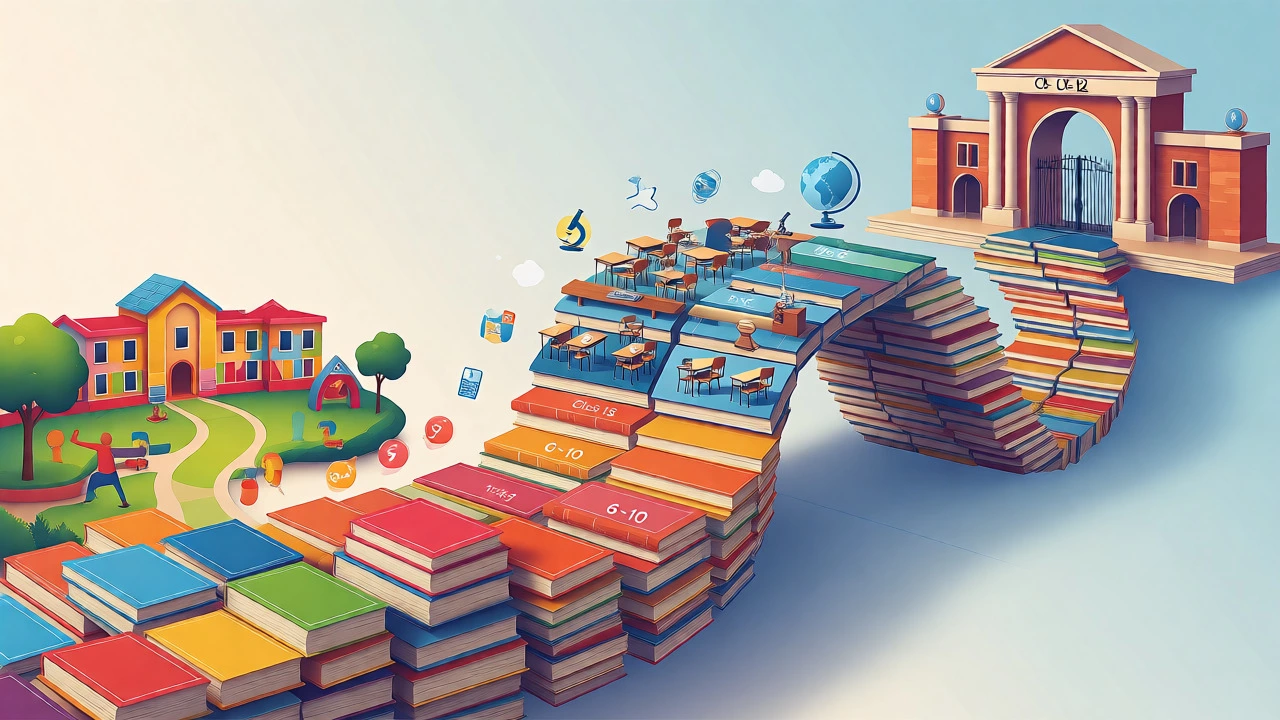
The CBSE syllabus is divided into three distinct stages. Each stage has different goals and teaching methods. Understanding where your child fits helps you support them better.
Foundational Stage (Classes 1-5)
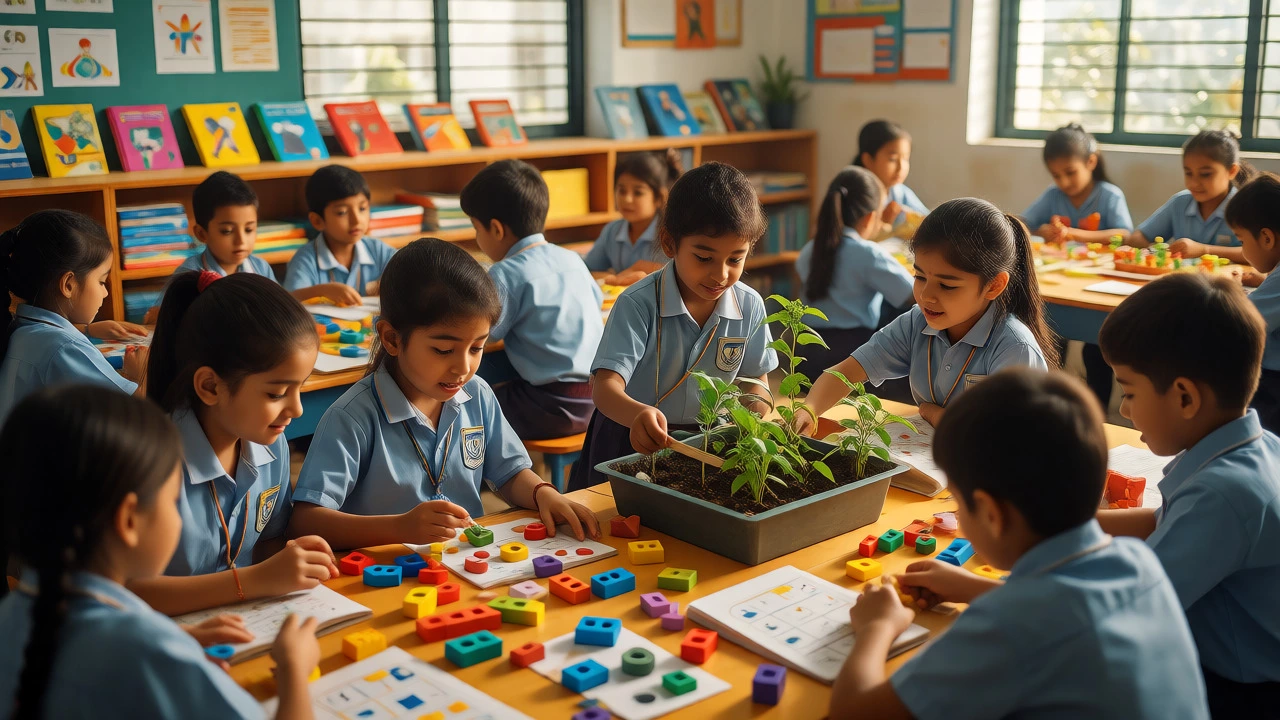
At this level, there are no traditional "subjects" like Physics or History. Instead, learning is integrated. Teachers use activity-based methods. For instance, math might be taught through shopping games, and science through gardening. The focus is on literacy, numeracy, and social skills. There are no formal exams until Class 3, and even then, they are often oral or practical.
Preparatory Stage (Classes 6-8)
This is where formal subjects begin. Students start studying Science, Social Studies, Mathematics, English, Hindi, and a third language. The syllabus introduces abstract concepts. In Math, they move from basic arithmetic to algebra. In Science, they explore physics basics like force and motion. Textbooks are primarily published by NCERT (National Council of Educational Research and Training). These books are concise and free online, making them accessible to everyone.
Middle and Secondary Stages (Classes 9-10)
Class 9 and 10 are critical because they lead to the first board exam. The syllabus expands significantly. Students choose streams later, but for now, everyone studies the same core subjects. Internal assessments account for 20% of the final grade, covering projects, presentations, and lab work. This reduces pressure slightly compared to older systems where one written exam decided everything.
Senior Secondary Stage (Classes 11-12)
Here, students specialize. You must choose a stream: Science, Commerce, or Humanities (Arts). This decision shapes university choices. The syllabus becomes highly specialized. A Science student won’t touch Economics unless they take it as an elective. A Commerce student dives deep into Accountancy and Business Studies. The complexity increases sharply, requiring strong analytical skills.
Subject-Wise Overview: What Do Students Actually Study?
Let’s look at the specific content within the major streams for Classes 11 and 12, as this is where most confusion lies.
| Stream | Core Subjects | Key Topics Covered |
|---|---|---|
| Science | Physics, Chemistry, Biology/Mathematics, English | Thermodynamics, Organic Chemistry, Genetics, Calculus, Vectors |
| Commerce | Accountancy, Business Studies, Economics, English | Partnership Accounts, Marketing Mix, Micro/Macro Economics, Statistics |
| Humanities | History, Political Science, Psychology, Sociology, English | World Wars, Indian Constitution, Cognitive Processes, Social Stratification |
In the Science stream, Mathematics is optional but recommended for engineering aspirants. Biology is mandatory for medical aspirants. The syllabus is heavy on formulas and derivations. For example, in Physics, students learn rotational mechanics and electromagnetic induction. These aren’t just theoretical; they form the basis of modern technology.
Commerce students spend significant time on financial statements. They learn to balance sheets and calculate ratios. It’s practical math applied to business. Economics splits into Microeconomics (individual markets) and Macroeconomics (national economies). Understanding inflation and GDP becomes part of their daily vocabulary.
Humanities is often misunderstood as "easy." It’s not. It requires extensive reading and essay writing. History involves analyzing sources and debates. Political Science covers governance structures and international relations. Psychology explores human behavior and mental health. These subjects build strong communication and analytical skills, valuable for law, civil services, and journalism.
The Role of NCERT Books in the CBSE Syllabus
You cannot talk about the CBSE syllabus without mentioning NCERT. These are the official textbooks prescribed by the board. Unlike private publishers that add extra fluff, NCERT books stick strictly to the syllabus. They are designed to be read cover-to-cover. Every question in the CBSE board exam can be answered using information found in these books.
For younger students, NCERT provides colorful illustrations and simple language. For older students, the tone becomes more academic. Many top rankers in JEE and NEET credit their success to mastering NCERT before touching reference books. Why? Because CBSE exams test conceptual clarity, not obscure trivia. If you understand the NCERT chapter thoroughly, you score well.
Parents should note: Don’t buy expensive guidebooks immediately. Start with NCERT. Use guides only for practice problems after the concept is clear. Overloading with multiple resources confuses students. Stick to the source material.
Practical Work and Internal Assessments
A common misconception is that CBSE is purely theory-based. That’s false. Practical work carries weightage, especially in Science and Computer Science. For Class 10 and 12 Science students, lab records are mandatory. You must conduct experiments, record observations, and submit files. Examiners visit schools to assess these practicals separately from the written paper.
Internal Assessment includes:
- Periodic Tests: Small quizzes held throughout the year.
- Notebook Submission: Checking if students maintain organized notes.
- Project Work: Long-term assignments, such as building a model or conducting a survey.
This system encourages consistent effort. You can’t cram two weeks before the exam and hope for high marks in internal assessment. Regular participation matters. For arts students, project work might involve creating a documentary or writing a research paper. This builds real-world skills like teamwork and presentation.
How to Access and Download the Official Syllabus
The CBSE updates the syllabus annually. Sometimes, they reduce content to lighten the load, especially after disruptions like the pandemic. Always check the latest version. Here’s how to find it:
- Visit the official CBSE website (cbse.gov.in).
- Navigate to the "Academics" section.
- Select "Curriculum & Syllabus."
- Choose your class level (e.g., Class 10 or Class 12).
- Download the PDF for each subject.
Read the introduction page of each PDF carefully. It lists learning outcomes and unit-wise weightage. Weightage tells you how many marks each chapter contributes. Focus more energy on high-weightage units. For example, if Algebra is 20% of the Math paper, don’t neglect it while obsessing over Geometry if it’s only 10%.
Common Pitfalls and Pro Tips
Students often make mistakes when interpreting the syllabus. Here are a few things to watch out for:
- Ignoring Deleted Chapters: CBSE sometimes removes chapters temporarily. Studying deleted topics wastes time. Check the current year’s notification.
- Skipping Lab Manuals: In Science, lab manuals contain crucial questions asked in practical exams. Don’t skip them.
- Underestimating Languages: English and Hindi contribute significantly to the total score. Improving grammar and comprehension boosts overall percentage easily.
- Last-Minute Stream Changes: Switching streams in Class 11 is difficult. The syllabus gap is too wide. Decide early based on interest, not peer pressure.
Another tip: Use the sample papers released by CBSE. They show the exact format of questions. Are there multiple-choice questions? Case-based scenarios? Short answers? Knowing the pattern reduces anxiety during the actual exam.
Final Thoughts: Making the Most of the Curriculum
The CBSE syllabus is comprehensive but manageable. It balances breadth and depth. For parents, the key is to stay informed about changes. For students, consistency beats intensity. Studying a little every day according to the syllabus timeline ensures retention. Remember, the syllabus is a map, not a prison. It guides you toward knowledge, but how you engage with it determines your success.
If you are new to the system, start small. Download the syllabus for the next term. Mark important dates. Create a simple study schedule. The structure is there to help you, not hinder you. Once you understand the layout, navigating CBSE becomes second nature.
Is the CBSE syllabus the same across all schools in India?
Yes, the core syllabus is uniform for all CBSE-affiliated schools. However, individual schools may have additional internal assessments or minor variations in teaching methods. The final board exam questions are set centrally by CBSE, ensuring consistency.
Do I need to buy separate books for CBSE?
NCERT books are mandatory and sufficient for scoring well in board exams. Reference books are optional and useful for competitive exam preparation like JEE or NEET. Start with NCERT to build a strong foundation.
How often is the CBSE syllabus updated?
The syllabus is reviewed annually. Minor tweaks happen regularly, while major changes occur every few years to align with educational policies. Always download the latest PDF from the official CBSE website at the start of the academic session.
What is the difference between CBSE and ICSE syllabus?
ICSE (Indian Certificate of Secondary Education) generally has a broader and deeper syllabus, especially in English and Science. CBSE is more focused on core concepts aligned with national entrance exams. CBSE is also more widely accepted across states for transfers.
Can I change my stream after Class 10?
Yes, you choose your stream (Science, Commerce, Arts) after Class 10. This choice is independent of your previous performance unless specific grades are required by the school. Choose based on your interests and career goals, not just past scores.