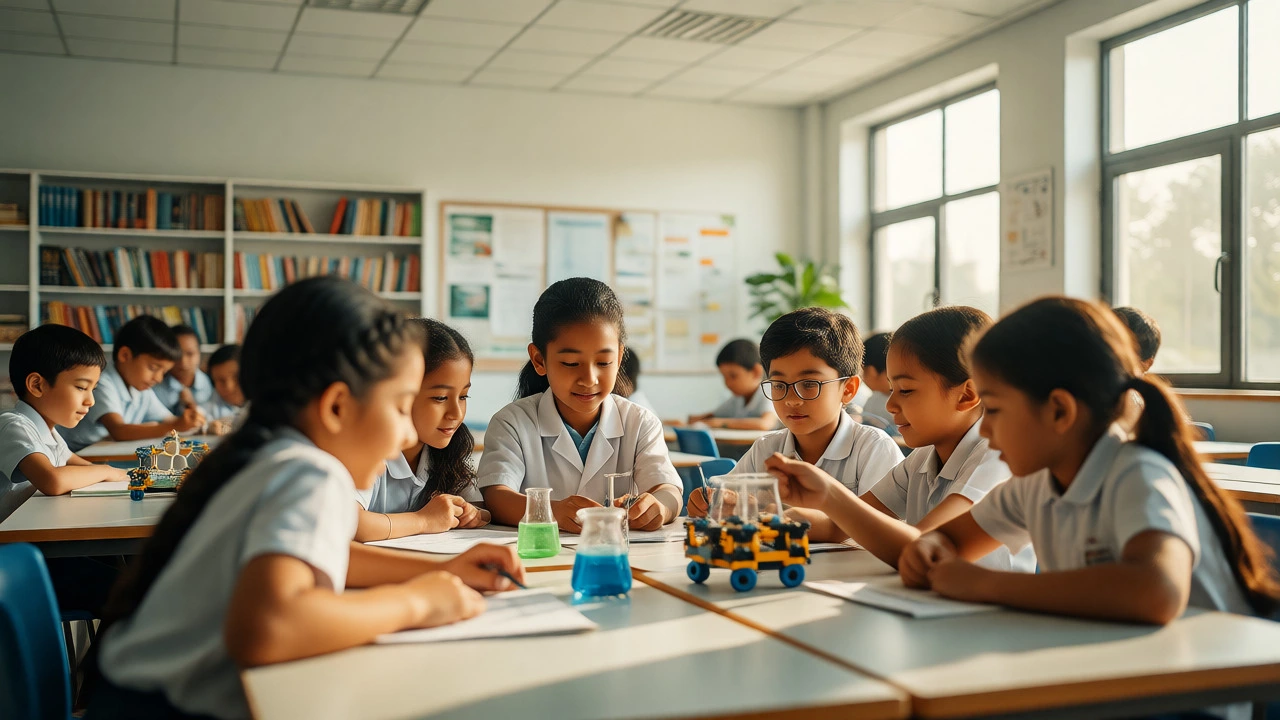
CBSE School Fit Finder
Answer these questions to see which board aligns best with your family's needs.
You’re standing in a school corridor in Delhi or Mumbai, holding a brochure that promises "holistic development," but you have no idea what that actually means for your child’s Tuesday morning math class. You hear the term CBSE (Central Board of Secondary Education) thrown around constantly by other parents, yet the distinction between it and state boards or ICSE remains blurry. Why does everyone say CBSE is "easier"? Is it really better for competitive exams like JEE or NEET? And most importantly, is it the right fit for your family if you move cities often?
Let’s cut through the noise. CBSE isn’t just an acronym; it’s a massive educational framework that dictates what millions of students learn from Class 1 to Class 12. It’s standardized, it’s centralized, and for many families, it’s the default choice because of its flexibility. But choosing a board is about more than just brand recognition-it’s about aligning with your child’s learning style and future career goals.
The Core Definition: What Exactly is CBSE?
The Central Board of Secondary Education (CBSE) is a national-level board of education in India for public and private schools, controlled and managed by the Union Government of India. It was established in 1952. Unlike state boards, which vary wildly from one region to another (think Kerala vs. Bihar), CBSE offers a uniform curriculum across the country. This means a student studying Grade 8 Physics in Chennai learns roughly the same concepts as a student in Kolkata or Dubai.
Think of CBSE as the "standard operating procedure" for Indian schooling. Its primary goal is to provide quality education with a focus on science and mathematics, while also integrating humanities and languages. The board doesn’t run the schools itself; instead, it affiliates them. This means thousands of private and government schools follow the CBSE syllabus, textbooks, and examination guidelines set by the central authority.
Why does this matter to you? If you are an expat parent or someone who moves frequently for work, this uniformity is a lifesaver. Your child won’t face a culture shock in academics when transferring schools. The continuity is seamless.
Curriculum Structure: What Do Kids Actually Learn?
The CBSE curriculum is divided into three stages: Primary (Classes I-V), Middle (VI-VIII), and Secondary (IX-XII). The philosophy has shifted significantly in recent years, especially after the National Education Policy (NEP) 2020 recommendations started trickling into implementation. The old rote-learning model is being replaced by competency-based education.
In the early years, the focus is on foundational literacy and numeracy. By middle school, subjects branch out. In high school (Grades 9-12), students choose streams: Science, Commerce, or Humanities. Here’s where things get specific:
- Science Stream: Heavy on Physics, Chemistry, Biology, and Mathematics. This is the pipeline for engineering and medical aspirants.
- Commerce Stream: Focuses on Accountancy, Business Studies, Economics, and Entrepreneurship. Ideal for future finance professionals.
- Humanities Stream: Covers History, Political Science, Psychology, Sociology, and Literature. Great for law, civil services, or journalism.
A key feature here is the inclusion of Artificial Intelligence and Computer Science as elective subjects from Class 9 onwards. This reflects the board’s attempt to stay relevant in a tech-driven world. Additionally, practical assessments are mandatory for sciences, ensuring students don’t just memorize formulas but understand lab procedures.
CBSE vs. ICSE vs. State Boards: Making the Choice
This is the big question every parent faces. Should you go for CBSE, the Indian Certificate of Secondary Education (ICSE, administered by CISCE), or your local State Board? Each has its pros and cons.
| Feature | CBSE | ICSE | State Board |
|---|---|---|---|
| Curriculum Focus | Science & Math heavy; concise content | Literature & English heavy; detailed content | Regional language & local history focus |
| Difficulty Level | Moderate; objective-type questions common | High; analytical and descriptive answers required | Varies; generally considered easier |
| Recognition | National; accepted everywhere in India | Global; strong international reputation | Local; sometimes issues with interstate transfers |
| Best For | JEE/NEET aspirants; mobile families | Students strong in English; overseas education | Budget-conscious families; regional careers |
If your child aims for Indian competitive exams like the Joint Entrance Examination (JEE) or National Eligibility cum Entrance Test (NEET), CBSE is the clear winner. The syllabus overlaps significantly with these entrance tests. ICSE, on the other hand, demands stronger writing skills and critical analysis, which can be advantageous for liberal arts colleges abroad but might feel overwhelming for a kid struggling with English.

Assessment Pattern: How Are Students Graded?
Gone are the days when a single final exam decided your fate. The CBSE assessment pattern now includes Continuous and Comprehensive Evaluation (CCE) elements, though the name has evolved into internal assessments. For Classes 9 and 10, and later for 11 and 12, grades are calculated based on:
- Internal Assessments: Periodic tests, assignments, projects, and practicals conducted by the school throughout the year.
- Board Exams: The final external examination conducted by CBSE at the end of the academic session.
This mix reduces the pressure on students. If a child falls sick during the final exam, their internal scores still count. Furthermore, CBSE has introduced "Competency-Based Questions"-these aren’t just memory recall; they test application. For example, instead of asking "Define photosynthesis," a question might ask students to analyze why a plant in a dark room dies despite having water and soil.
Admission Process and Fees: What to Expect
Getting into a good CBSE school can be competitive, especially in metros like Bangalore or Hyderabad. Most reputable schools start their admission process in November or December for the following April session. You’ll need documents like birth certificates, previous report cards, and transfer certificates.
Fees vary drastically. A basic CBSE-affiliated school in a tier-3 town might charge ₹15,000-₹30,000 annually. In contrast, premium urban schools can charge ₹1,00,000-₹3,00,000+ per year. Always ask for the fee structure breakdown. Look for hidden costs like transportation, technology fees, or annual registration charges.
Pro Tip: Check if the school is affiliated with Kendriya Vidyalaya Sangathan (KVS) or Navodaya Vidyalaya Samiti (NVS). These are government-run CBSE institutions known for discipline and low fees, though getting a seat there often requires priority based on parental employment (government jobs) or rural background.
Challenges and Criticisms
No system is perfect. Critics argue that CBSE focuses too much on STEM (Science, Technology, Engineering, Math) at the expense of arts and vocational training. While the new policy tries to fix this, the perception lingers. Another complaint is the "ratta" (rote) culture. Despite changes, many teachers still rely on textbook memorization rather than fostering curiosity.
Also, consider the teacher-to-student ratio. In some large CBSE schools, classes can exceed 40 students, making personalized attention difficult. Visit the campus. Talk to current parents. Ask about how they handle struggling students. Does the school offer remedial classes? Is counseling available?
Future-Proofing: CBSE and Higher Education
Does CBSE prepare kids for college? Yes, particularly within India. Universities like the Indian Institutes of Technology (IITs) and All India Institute of Medical Sciences (AIIMS) align their entrance criteria closely with the CBSE syllabus. For study abroad, CBSE is widely recognized, though top-tier US or UK universities may look at holistic profiles beyond just marks.
If you plan for international undergraduate studies, ensure your child takes advanced electives in Class 11 and 12. Many CBSE schools now offer Cambridge International (CAIE) tracks alongside CBSE, giving students dual exposure. This hybrid approach can be a strategic advantage, offering the rigor of CBSE with the global acceptance of Cambridge qualifications.
Is CBSE harder than State Board?
Generally, yes, compared to most State Boards. CBSE covers a broader range of topics and emphasizes conceptual understanding over simple memorization. However, it is often considered less voluminous than ICSE. The difficulty is moderate, designed to prepare students for national-level competitive exams.
Can I switch my child from State Board to CBSE in Class 10?
It is possible but challenging. The syllabi differ significantly. You would need to enroll your child in a CBSE-affiliated school that accepts mid-session admissions and provide extra coaching to bridge the gap in subjects like Science and Social Studies. It is usually recommended to switch before Class 9 to allow time for adjustment.
Are CBSE schools good for students weak in English?
Yes, CBSE is more forgiving than ICSE regarding English proficiency. The grammar and literature requirements are standard, not exhaustive. Many CBSE schools offer Hindi or regional languages as second languages, allowing students to strengthen their mother tongue while learning English as a medium without the intense literary pressure found in ICSE.
How does CBSE support students with special needs?
CBSE provides concessions for students with disabilities, including scribes, extended time in exams, and modified question papers. Schools are increasingly adopting inclusive practices under the Rights of Persons with Disabilities Act, though implementation varies by institution. Always check the specific school's infrastructure for accessibility.
Is CBSE recognized internationally?
Yes, CBSE is recognized globally. Universities in the USA, UK, Canada, Australia, and Europe accept CBSE results for admission. However, for highly selective courses, they may require additional standardized tests like SAT or ACT. The uniform grading scale makes it easy for foreign evaluators to assess performance.