IB vs CBSE: Key Differences and Which One Fits Your Child
When parents choose between the IB, the International Baccalaureate is a globally recognized, inquiry-based curriculum focused on critical thinking and holistic development and the CBSE, the Central Board of Secondary Education is India’s most widely followed school board, known for its structured syllabus aligned with competitive exams like JEE and NEET, they’re not just picking a school—they’re choosing a learning philosophy. The IB vs CBSE debate isn’t about which is harder, but which matches your child’s goals. IB pushes students to ask why, while CBSE teaches them how to answer what’s on the test.
IB students spend years writing extended essays, doing community projects, and learning through real-world problems. It’s designed for kids who thrive when they connect ideas across subjects—like linking biology to ethics or math to global economics. CBSE, on the other hand, builds strong foundational knowledge in science and math, with clear syllabi and predictable exam patterns. That’s why so many CBSE students end up cracking JEE and NEET: the system trains them for high-stakes, fact-heavy exams. But IB doesn’t ignore those exams—it just prepares students differently. A 2023 study of Indian students in top global universities showed IB graduates adapted faster to university-style learning, while CBSE students often had stronger technical recall.
Another big difference? International Baccalaureate, a curriculum used in over 5,000 schools worldwide, accepted by universities in the US, UK, Canada, Australia, and Europe without additional entrance exams is recognized globally. If your child might study abroad, IB gives them a direct passport. CBSE is trusted in India and accepted by most foreign universities too—but sometimes requires extra steps like SAT or IELTS. Cost is another factor: IB schools often charge 2–5 times more than CBSE schools. And while CBSE has over 20,000 affiliated schools across India, IB is limited to a few hundred, mostly in metro cities.
What about stress? CBSE can feel like a race—lots of rote learning, heavy syllabus, and pressure to score high in board exams. IB spreads the workload over two years with internal assessments, so there’s no single make-or-break test. But IB demands constant writing, research, and self-management. It’s not easier—it’s just different. One student might love the freedom of IB; another might panic without clear syllabus boundaries.
If your child is aiming for engineering or medicine in India, CBSE gives them a head start. If they’re curious, creative, and thinking about studying overseas, IB opens more doors. And if you’re unsure? Look at how your child learns. Do they thrive with structure and clear goals? CBSE might be better. Do they ask questions no textbook answers? IB could be their fit.
Below, you’ll find real insights from parents, teachers, and students who’ve walked both paths—whether it’s about choosing the right coaching for JEE after CBSE, how IB prepares students for life beyond exams, or why some families switch boards mid-way. No theory. Just what actually works.
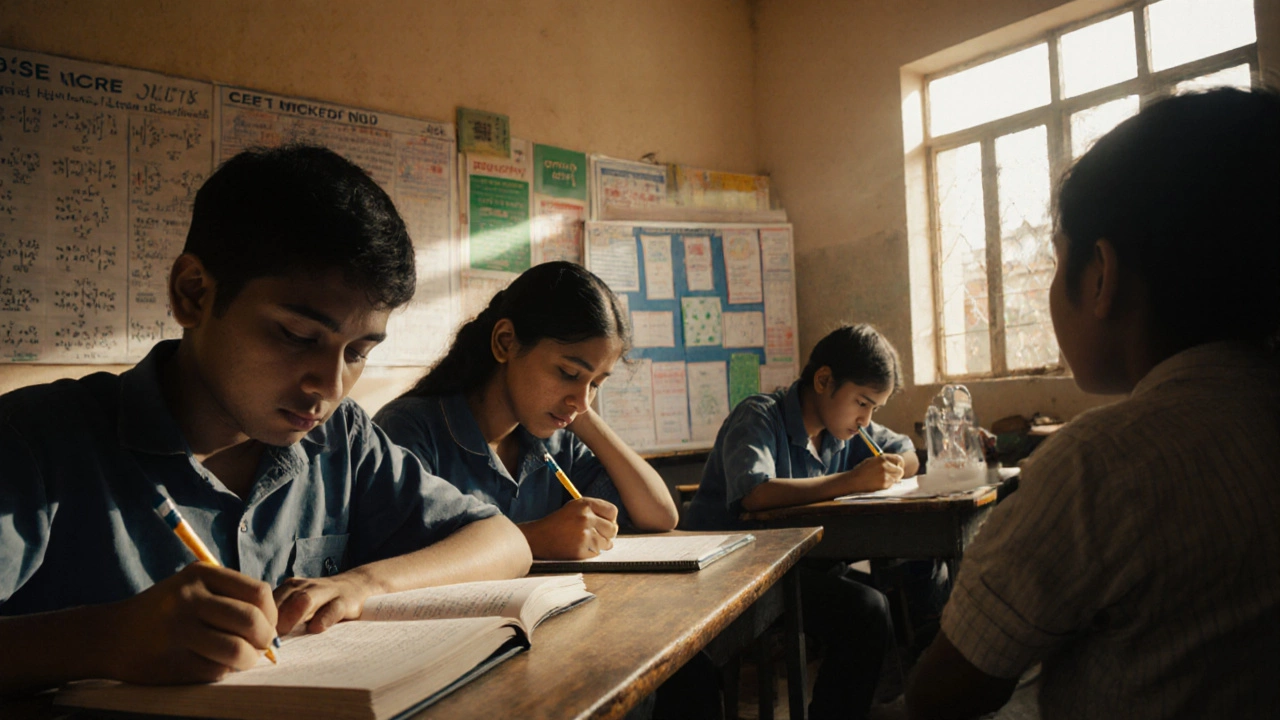
Which syllabus is best in the world? CBSE vs IB vs Cambridge vs State Boards
There's no single best syllabus in the world - CBSE, IB, or Cambridge each serve different goals. This guide compares them for Indian families deciding on school education paths.
read more...