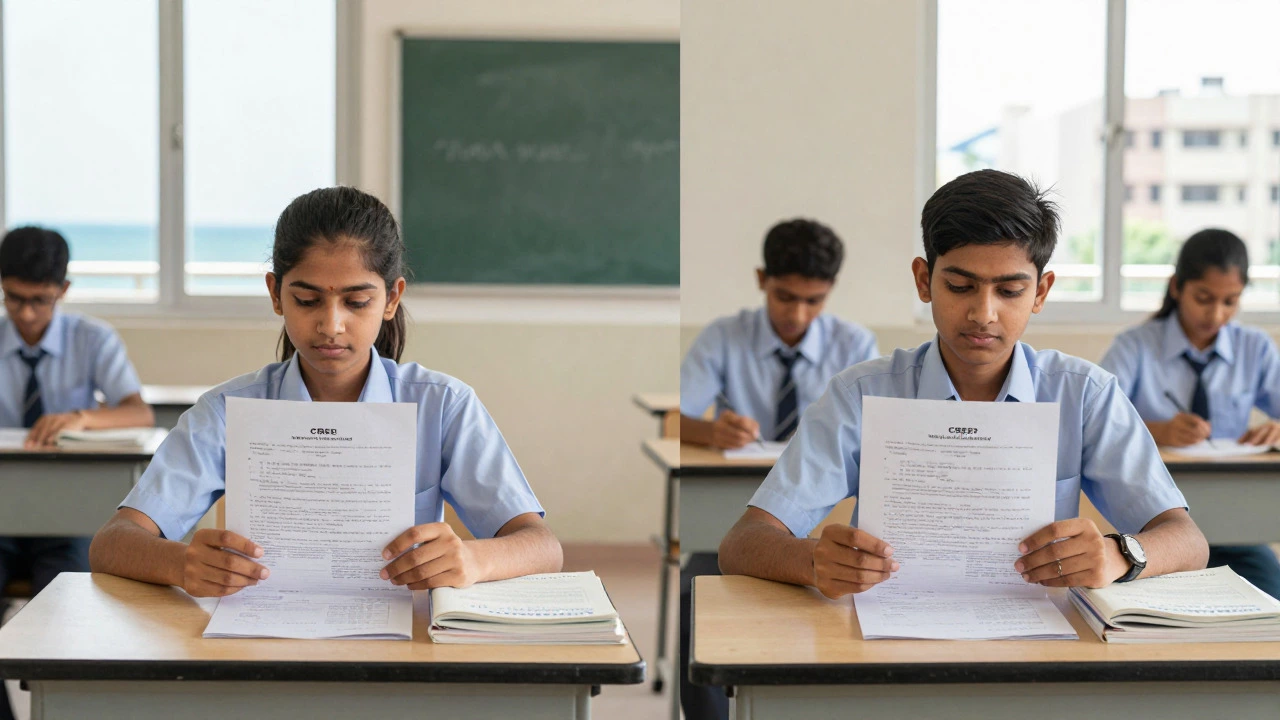
CBSE Exam Uniformity Checker
Exam Component Status
Analyzing...
Loading insight...
Preparation Tip:
- Loading tips...
You sit down to take your Class 10 or 12 board exams in Mumbai. Your cousin takes the exact same exam at the same time in Delhi. Are you looking at the same questions? If you are a student, parent, or teacher in the Central Board of Secondary Education (CBSE), which is India's largest school education board under the Ministry of Education, this question often causes unnecessary stress. The short answer is yes, but with important nuances regarding language options and regional centers.
The Core Principle: One Board, One Standard
The defining feature of the CBSE is its centralization. Unlike state boards, which create their own papers for each district or state, the CBSE operates from New Delhi and sets the standard for over 28,000 affiliated schools nationwide. When the board announces that the "question paper is uniform," it means exactly that. The core academic content-the physics problems, the history dates, the literature excerpts-is identical for every student taking the main English-medium exam across the country.
This uniformity is not just a policy choice; it is a logistical necessity. With millions of students appearing for the exams simultaneously, maintaining a single set of high-quality questions ensures fairness. It prevents leakage on a massive scale because there are fewer versions to protect. For a student moving from Jaipur to Bangalore mid-year, this consistency means they do not have to relearn a completely different curriculum style. They simply continue with the same NCERT textbooks, which are the official prescribed textbooks for all CBSE subjects.
Language Options: Where the Papers Diverge
While the science and math papers remain strictly uniform, the language section introduces the first major variation. The CBSE offers multiple language options, including Hindi, Sanskrit, Urdu, French, German, and various Indian regional languages like Tamil, Bengali, and Marathi.
If you choose Hindi as your second language, your paper will be entirely different from the student who chose French. This is expected. However, even within the same language code, there can be slight variations in the "First Language" (L1) assessment. Some schools offer an internal assessment component for L1 that may vary slightly in format based on school-level discretion, though the external board exam remains standardized. For the external written test, if two students both select "Hindi B," they receive the exact same paper. If one selects "Hindi A" and another "Hindi B," the difficulty level and specific questions differ, reflecting the proficiency levels associated with each course code.
Regional Centers and Administrative Logistics
To manage the sheer volume of exams, the CBSE divides India into several Regional Offices (ROs), such as RO Delhi, RO Mumbai, and RO Chennai. These offices handle administration, invigilation, and result processing for schools in their respective zones. Does the Regional Office change the paper? No. The paper is printed centrally and distributed securely to these regions.
However, the region does matter for practical reasons. If a student belongs to the Delhi region, their application number starts with 'D'. If they belong to the Mumbai region, it starts with 'M'. This coding helps in tracking attendance and managing center allocations. In rare cases of natural disasters or security threats affecting a specific city, the CBSE might delay exams locally, but the content of the paper remains the same once the exam proceeds. The uniformity holds true regardless of whether you are in a metro city or a rural town in Bihar.
| Exam Component | Uniform Across India? | Notes on Variation |
|---|---|---|
| Science & Mathematics | Yes | Identical questions for all students selecting the same subject stream. |
| English Core | Yes | Same paper for all students opting for English Core. |
| Second Languages | No | Papers differ based on the language chosen (e.g., Hindi vs. Sanskrit). |
| Internal Assessments | No | Schools conduct these internally; formats may vary by school policy. |
| Marking Scheme | Yes | Centralized evaluation centers use a unified rubric for grading. |

The Role of Centralized Evaluation
A common misconception is that because papers are sent to different cities for printing, they might also be graded differently. In reality, the CBSE uses a system of centralized evaluation. Answer sheets are scanned and sent to designated evaluation centers, often located in universities or large institutions. Examiners are appointed by the board and trained to follow a strict Marking Scheme, which is a detailed guide specifying points awarded for each part of an answer.
This process minimizes regional bias. An examiner in Kolkata grading a paper from a school in Kerala follows the same digital rubric as an examiner in Pune grading a paper from Assam. The introduction of Computer Based Evaluation (CBE) has further reduced human error and variance. Since the late 2010s, most subjective answers are typed by data entry operators and displayed to evaluators without any identifying information about the student’s location or school. This blind evaluation reinforces the principle that the standard is national, not local.
Impact of NEP 2020 and Recent Changes
The National Education Policy (NEP) 2020 has introduced some shifts in how assessments are viewed, emphasizing competency-based learning over rote memorization. While the physical paper remains uniform, the *style* of questions has evolved. You will see more case-study-based questions and critical thinking prompts rather than simple recall. This shift applies uniformly across India. Whether you are in a private international-style school in Gurgaon or a government-aided school in Patna, the move towards competency-based questioning is synchronized.
Additionally, the new curriculum reduces the volume of content, allowing for deeper understanding. This reduction is applied to the national syllabus, meaning the "same paper" now covers less breadth but more depth compared to previous years. Students should not expect different topics based on their region; the syllabus cut-down is universal.

What About Private and International Schools?
It is crucial to distinguish between CBSE-affiliated schools and those offering other curricula. Many private schools in India offer ICSE, IB (International Baccalaureate), or State Board curriculums. If a school is officially affiliated with the CBSE, it must adhere to the national paper. There is no such thing as a "private CBSE paper." All affiliated schools submit their results to the central board.
However, some schools conduct pre-board exams or mock tests that mimic the CBSE pattern. These internal tests may vary in quality and difficulty depending on the school's resources. Do not confuse these internal mocks with the actual board exam. The real board exam, conducted in February-March for Class 10 and March-April for Class 12, is the only one where the uniformity guarantee applies.
Practical Tips for Students
Knowing that the paper is uniform changes how you should prepare. Here is what you need to keep in mind:
- Stick to NCERT: Since the paper is uniform and based on the national syllabus, deviating into obscure reference books can waste time. The majority of direct questions come from NCERT texts.
- Practice Previous Year Questions (PYQs): Because the pattern is consistent, analyzing PYQs from the last 5-10 years gives you a clear picture of the question style. A question asked in Delhi five years ago is likely to appear in a similar format in Mumbai today.
- Ignore Regional Rumors: Sometimes, rumors spread that "papers are easier in certain states." This is false for the written exam. Differences in pass percentages usually stem from coaching culture and school support systems, not from different question papers.
- Focus on Presentation: Since evaluation is centralized and digital, neat handwriting translates to clear typing in the CBE system. Structured answers help evaluators award marks quickly and accurately according to the uniform marking scheme.
Conclusion on Uniformity
The CBSE exam paper is indeed the same all over India for students enrolled in the same subject and language combination. This uniformity is a cornerstone of the board's credibility, ensuring that a grade earned in one corner of the country holds the same value in another. While administrative regions exist for logistics, they do not influence the content of the exam. For students, this means preparation should focus on mastering the national curriculum rather than worrying about local variations. The playing field is level, and the rules are the same for everyone.
Is the CBSE Class 10 paper the same in every state?
Yes, for students taking the same subjects and languages, the Class 10 CBSE paper is identical across all states in India. The board distributes the same question paper to all examination centers nationwide.
Do different regions have different marking schemes?
No. The CBSE releases a single, unified marking scheme for each subject before the evaluation begins. All examiners across different regions use this same document to grade answer sheets, ensuring consistency.
Why do pass percentages vary between cities if the paper is the same?
Variations in pass percentages are due to differences in student preparation, access to coaching, and school infrastructure, not the exam paper itself. Metro cities often have higher concentrations of coaching centers, which can influence outcomes.
Can a student transfer from one CBSE school to another and face a different syllabus?
Generally, no. All CBSE-affiliated schools follow the same national curriculum and NCERT textbooks. However, individual schools may teach at different paces or emphasize certain topics more heavily, so students should review the current year's syllabus upon transfer.
Are internal assessments uniform across all CBSE schools?
No. Internal assessments are conducted by the respective schools. While the CBSE provides guidelines on weightage and broad areas, the specific projects, tests, and practical records evaluated internally can vary from school to school.