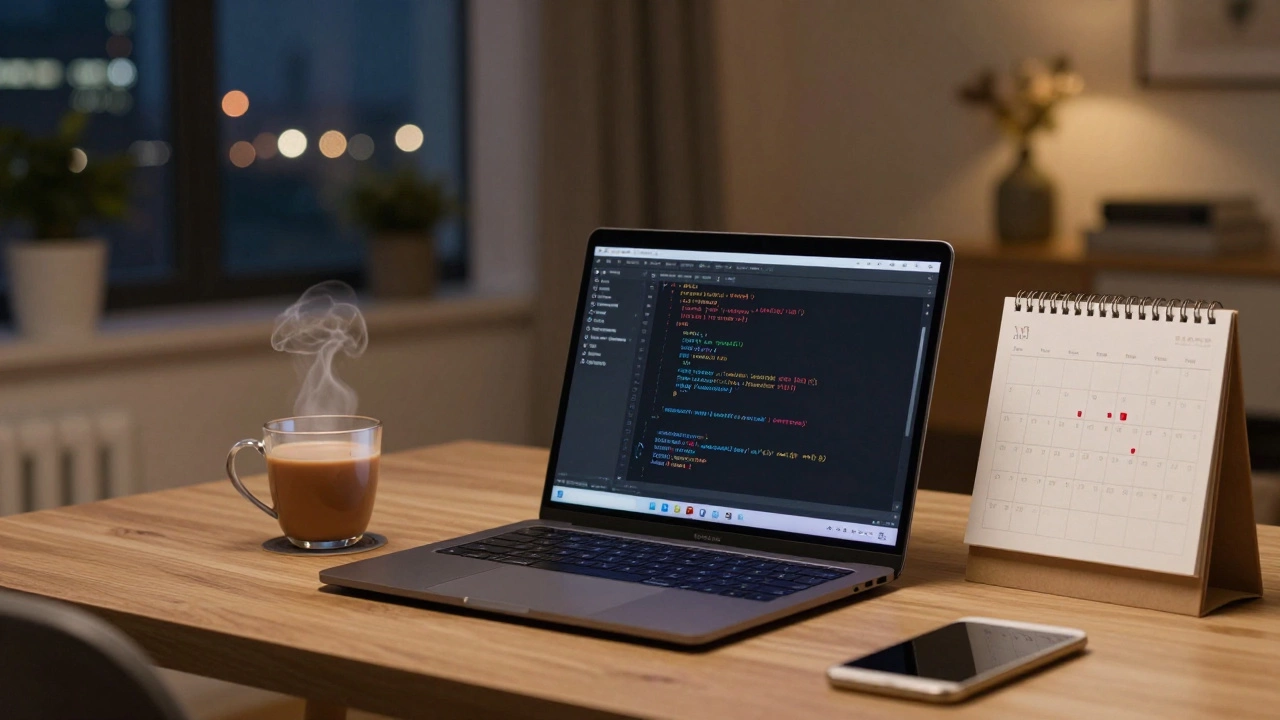
Daily Coding Progress Calculator
Consistency beats intensity. See how your daily habit compounds over time.
Your Golden Hour Structure
Based on the "Golden Hour" method from the article:
Picture this: you have exactly sixty minutes between your evening chores and dinner. You open your laptop, stare at a blank code editor, and wonder if that tiny window is enough to actually learn how to build software. The short answer is yes. One hour a day is more than enough to go from zero to job-ready, provided you treat that hour with surgical precision.
The long answer is messier. It depends on what you’re trying to build, how much you already know, and whether you’re treating coding like a hobby or a career pivot. If you’ve been told you need eight hours of study to make progress, someone is selling you anxiety. In reality, consistency beats intensity every single time in programming, which is the process of designing and building an executable computer program to accomplish a specific computing result.
The Science of Micro-Learning
Your brain doesn’t learn by osmosis. It learns through repetition and spacing. When you cram for six hours on Sunday, you burn out by Monday morning. Your neural pathways haven’t had time to solidify the new concepts. This is why the "one-hour rule" works so well for beginners. It aligns perfectly with cognitive science principles regarding spaced repetition.
Think of coding like learning a musical instrument. If you want to play guitar, practicing for one focused hour daily will get you further in six months than playing for ten hours once a week. Why? Because coding requires muscle memory for syntax and mental models for logic. These are built through frequent, short exposures, not marathon sessions.
- Retention: Daily review prevents the "forgetting curve" from erasing what you learned yesterday.
- Momentum: Starting is the hardest part. A one-hour commitment feels manageable, reducing procrastination.
- Feedback Loops: You encounter errors, fix them, and sleep on the solution, allowing your subconscious to work on it overnight.
If you are looking into coding classes that promise rapid results, remember that the platform matters less than your schedule. Whether you use a structured curriculum or free resources, the daily habit is the engine of your progress.
How to Structure Your Golden Hour
Sitting down for an hour without a plan is a recipe for doom-scrolling through documentation. You need a rigid structure for that sixty minutes to ensure you’re actually coding, not just watching videos about coding. Here is a breakdown of how to spend that hour effectively.
- Minutes 0-5: Review. Look at what you did yesterday. Re-read your notes or run the previous day’s code. This primes your brain.
- Minutes 5-25: Learn New Concept. Watch a tutorial, read a chapter, or follow a guide. Focus on one specific topic (e.g., "how loops work" or "CSS flexbox").
- Minutes 25-50: Build Something. This is non-negotiable. Type the code yourself. Break it. Fix it. Do not copy-paste. If you’re learning Python, write a script that renames files. If it’s JavaScript, make a button change color.
- Minutes 50-60: Plan Tomorrow. Write down exactly what you will tackle next session. This reduces friction when you sit down tomorrow.
The key here is active recall. Passive consumption-watching a lecture without typing-gives you a false sense of competence. You might understand the video, but when you open the editor, your hands won’t know what to do. That gap is where real learning happens.

Choosing the Right Language for Short Sessions
Not all programming languages are created equal when it comes to quick wins. Some languages require heavy setup, complex environments, and deep theoretical understanding before you see any output. Others give you immediate visual feedback, which keeps motivation high during those short daily bursts.
| Language | Best For | Setup Difficulty | Feedback Speed |
|---|---|---|---|
| Python | Data analysis, automation, back-end | Low | Fast (print statements) |
| JavaScript | Web development, interactivity | Medium | Instant (browser console) |
| HTML/CSS | Website structure and design | Very Low | Instant (visual changes) |
| C++ | Systems programming, games | High | Slow (compile times) |
If you are a complete beginner, start with HTML and CSS or Python. They offer the highest ratio of effort to reward. You can build a simple webpage or automate a boring task in under an hour. With C++ or Java, you might spend half your hour just configuring your development environment. That kills momentum.
The Trap of Tutorial Hell
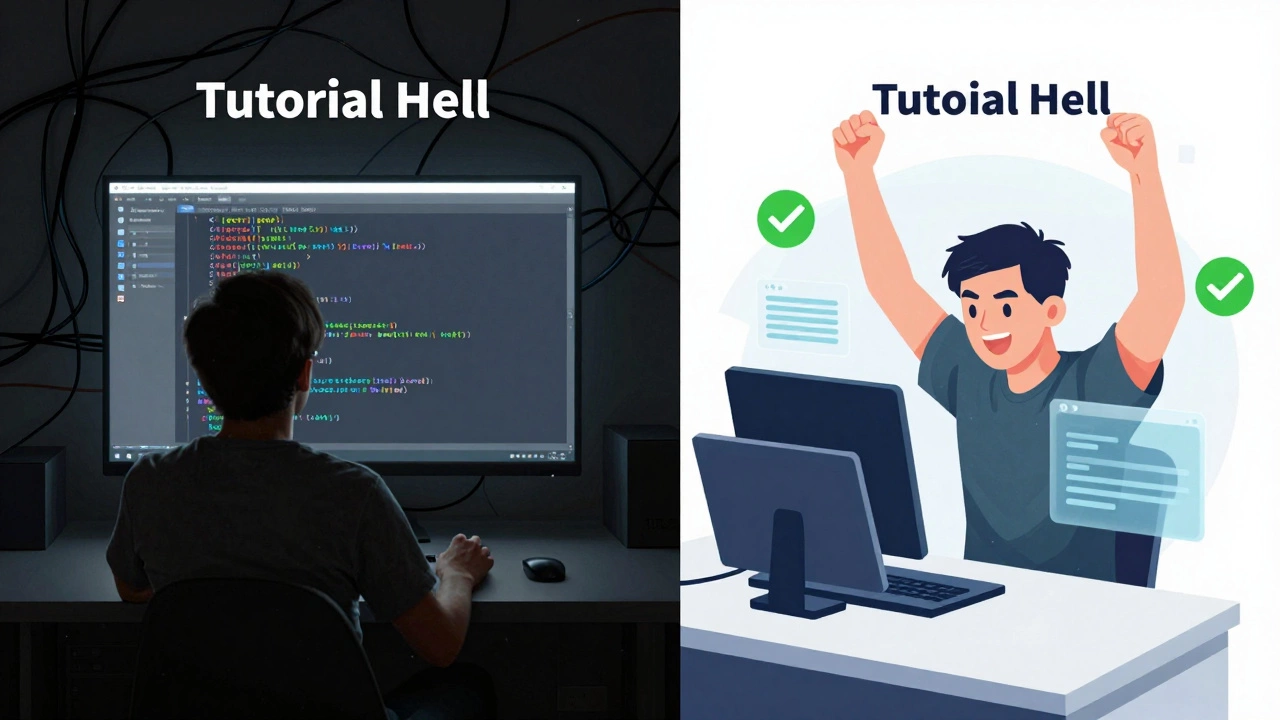
Here is the biggest risk when studying one hour a day: getting stuck in "tutorial hell." This is when you watch endless tutorials but never build anything on your own. You feel productive because you’re consuming content, but you aren’t developing problem-solving skills.
To avoid this, apply the 30% Rule. Spend no more than 30% of your hour consuming information. The other 70% must be spent writing code that isn’t directly copied from a source. If you’re following a tutorial, pause it every five minutes and try to predict what the next line of code should be. Then check if you were right.
Real-world coding is mostly debugging and searching for answers. Tutorials rarely teach you how to read error messages or use Stack Overflow effectively. By forcing yourself to build small projects within that hour, you simulate the actual job of a developer. You learn how to break things and put them back together.
Tracking Progress Without Burnout
When you only have an hour, it’s easy to feel like you’re not moving fast enough. You compare yourself to bootcamp graduates who studied eight hours a day for three months. But life isn’t linear. Consistency compounds over time.
One hour a day equals seven hours a week. That’s roughly 30 hours a month. In a year, that’s 365 hours of deliberate practice. Most entry-level jobs don’t require thousands of hours of experience; they require the ability to solve basic problems confidently. Three hundred and sixty-five hours is plenty to build a portfolio of small projects that demonstrate competence.
Track your streaks, not just your lines of code. Use a calendar or an app to mark each day you code. The goal is to keep the chain unbroken. If you miss a day, don’t quit. Just get back on track the next day. Perfection is the enemy of progress. A messy hour of coding is infinitely better than a perfect zero.
When One Hour Isn’t Enough
There are scenarios where one hour falls short. If you are preparing for a technical interview in two weeks, you need more volume. If you are trying to build a complex full-stack application with a tight deadline, you’ll need larger blocks of time for deep focus.
However, for the initial learning phase-understanding variables, functions, loops, and basic data structures-one hour is optimal. Once you hit intermediate levels, you might find you need longer sessions to tackle complex architecture problems. But you can’t reach intermediate level without first surviving the beginner phase. And that phase is best conquered with daily, bite-sized efforts.
Don’t wait until you have a free weekend to start. Start tonight. Open your editor. Write one line. That’s how careers begin.
Can I get a job as a developer with only 1 hour of study per day?
Yes, but it will take longer. At one hour a day, expect 12-18 months to reach a junior developer level. Employers care more about your portfolio and problem-solving ability than how many hours you studied. Consistent daily practice builds the muscle memory needed for technical interviews.
Is it better to study 1 hour daily or 7 hours on Sunday?
Daily study is significantly better. Cognitive science shows that spaced repetition improves retention. Studying seven hours on Sunday leads to burnout and rapid forgetting. Daily practice keeps concepts fresh and builds a sustainable habit.
What should I build in my first week of coding?
Start small. If using Python, build a number guessing game or a simple calculator. If using web technologies, create a personal profile page with HTML and style it with CSS. Avoid complex apps like social networks. Simple projects teach fundamentals without overwhelming you.
Do I need expensive coding classes to succeed?
No. Free resources like freeCodeCamp, The Odin Project, and official documentation are sufficient. Expensive classes provide structure and community, which can help with accountability, but they don't replace the actual practice. Your discipline matters more than the price tag.
How do I stay motivated when I don't understand the code?
Confusion is part of the process. When stuck, take a five-minute break, then re-read the error message. Break the problem into smaller parts. Remember that every expert was once a beginner who didn't understand. Celebrate small wins, like fixing a bug, rather than focusing on the big picture immediately.