IIT JEE Competition Funnel Calculator
Input Variables
Quick Breakdown of JEE Numbers
Before we dig into the trends, here is the high-level view of what the numbers usually look like in a typical academic cycle.
| Exam Stage | Approximate Candidates | Purpose |
|---|---|---|
| JEE Main | 1.2 to 1.5 Million | NITs, IIITs, GFTIs, and qualifying for Advanced |
| JEE Advanced | 250,000 to 300,000 | Admission specifically to IITs |
| IIT Seats | 17,000 to 18,000 | Final capacity across all IITs |
The Massive Surge in JEE Main Applicants
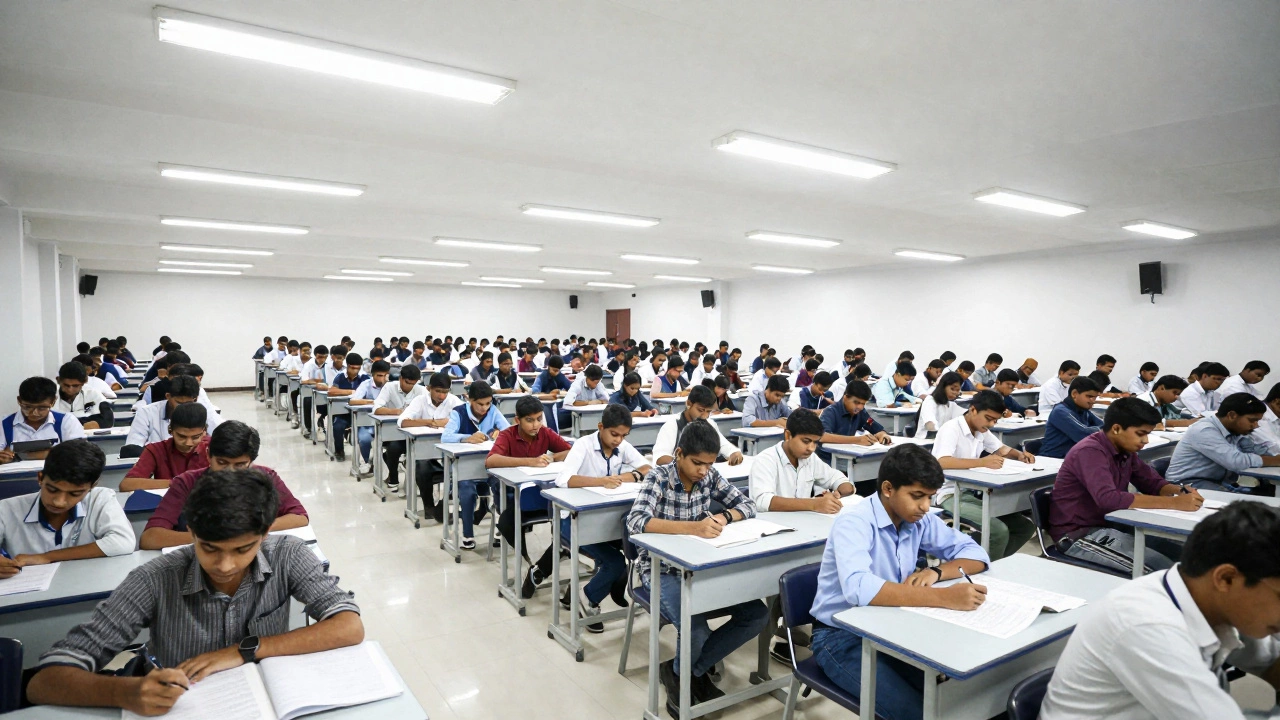
For years, the number of people appearing for JEE Main has been climbing. Why is this happening? It is not just about a growing population. There is a massive cultural shift toward STEM (Science, Technology, Engineering, and Mathematics) and a growing awareness of the prestige associated with engineering degrees. In recent years, we have seen the numbers consistently hover between 1.1 million and 1.4 million registrants.
When you look at these numbers, you have to consider the 'ghost' candidates-students who register but don't actually show up to the center. However, even after subtracting those, the active competition remains staggering. This high volume puts immense pressure on the National Testing Agency (NTA), the body responsible for conducting the exam, leading to the implementation of multiple shifts and computer-based testing to manage the crowd.
Filtering the Crowd: The Path to JEE Advanced
Not everyone who takes the first test gets to move forward. The JEE Advanced acts as a brutal filter. To be eligible, a student must be among the top 2,50,000 successful candidates from JEE Main. This creates a sharp drop-off in numbers.
Think of it as a funnel. You start with 1.2 million people, and suddenly you are down to about 2.5 lakh (250,000) eligible students. But here is the catch: not all eligible students actually sit for the Advanced exam. Many choose to take a seat in a National Institute of Technology (NIT) through their Main score rather than risk another grueling test. This means the actual number of test-takers for Advanced is often lower than the eligibility limit.
The Math of the IIT Dream
Let's talk about the actual seats. While millions apply, the Indian Institutes of Technology (IITs) have a fixed capacity. Across the 23 IITs in India, the total number of seats for B.Tech programs is roughly 17,000 to 18,000.
If we take the 250,000 students eligible for JEE Advanced, the success rate for getting into an IIT is roughly 7%. If you look at it from the perspective of the 1.2 million who started at JEE Main, the probability drops to about 1.5%. This is why the preparation is often described as a 'war'-the odds are mathematically stacked against the average student.
Why the Numbers Keep Growing
You might wonder why people keep applying despite these odds. It comes down to the Return on Investment (ROI). An IIT degree is almost a golden ticket to high-paying jobs in the US or Europe, or a fast track to leadership roles in India's booming tech sector. The allure of companies like Google or Microsoft recruiting directly from campuses makes the struggle worth it for many.
Additionally, the rise of coaching hubs in cities like Kota has industrialized the preparation process. More students are being pushed into this funnel from a younger age (often starting in 8th or 9th grade), which artificially inflates the number of serious contenders every year.
Comparing the Competition Levels
To put the IIT JEE competition in perspective, it helps to compare it with other major Indian exams. The NEET (National Eligibility cum Entrance Test) for medical aspirants often sees even higher numbers, sometimes crossing 2 million applicants. However, the 'filtering' process in JEE is more tiered, making the jump from Main to Advanced a distinct psychological and academic hurdle that NEET doesn't have in the same way.
| Metric | IIT JEE (Main) | NEET (UG) |
|---|---|---|
| Annual Applicants | ~1.2 - 1.5 Million | ~2.0 - 2.5 Million |
| Filter Mechanism | Two-stage (Main & Advanced) | Single-stage |
| Competitive Intensity | Extreme (Top 1% focus) | Extreme (High Volume) |
Pitfalls of Focusing Only on the Numbers
It is easy to get intimidated by the 1.2 million figure, but here is a pro tip: most of those students are not your actual competition. In any massive exam, there is a huge percentage of 'casual' applicants-students who take the test just to see where they stand or because their parents insisted.
The real competition usually consists of the top 50,000 to 100,000 students who have consistent study habits, high-quality resources, and a strategic approach to the syllabus. If you can move yourself into that bracket, the 1.2 million number becomes irrelevant. You aren't fighting the crowd; you are fighting the top tier.
Does the number of applicants increase every year?
Yes, there has been a steady upward trend over the last decade. This is due to better access to education in rural areas, the growing prestige of engineering, and the increasing number of students opting for the science stream in high school.
Is it harder to get into an IIT now than 20 years ago?
Mathematically, yes. While the number of IITs has increased (from 7 to 23), the number of applicants has grown at a much faster rate. The level of preparation has also evolved, with students using advanced digital tools and specialized coaching, making the cutoff marks generally higher and the competition more fierce.
What is the difference between JEE Main and JEE Advanced candidates?
JEE Main is the open entry point for all aspiring engineers. Only the top 250,000 scorers from JEE Main are allowed to sit for JEE Advanced. Therefore, the Advanced pool is a curated, high-performance group of students.
What happens if I don't make it to the top 250,000?
You can still secure a seat in National Institutes of Technology (NITs), Indian Institutes of Information Technology (IIITs), and other Government Funded Technical Institutions (GFTIs) based on your JEE Main rank.
How many seats are available in total for IITs?
Total seats vary slightly by year, but they generally fall between 17,000 and 18,000 for undergraduate B.Tech programs across all the IITs combined.
Next Steps for Aspirants
If you are overwhelmed by these numbers, stop looking at the million and start looking at the syllabus. The best way to handle the scale of the IIT JEE is to focus on micro-goals. Instead of worrying about 1.2 million people, focus on mastering one chapter of Organic Chemistry or solving ten complex physics problems today.
For those who find the gap too wide, consider diversifying your options. Looking into BITSAT for BITS Pilani or state-level entrance exams can provide a safety net and reduce the anxiety associated with the massive crowds of the JEE. Remember, the goal is a great engineering education, and while IITs are the peak, there are many other paths to a successful career in tech.