
English Speaking Confidence Builder
Answer these questions honestly to determine your current comfort level with speaking English.
Shadowing Technique: Listen to native speakers and repeat what they say simultaneously. This builds muscle memory for pronunciation and rhythm without the pressure of original thought.
Assessing...
Please complete the assessment above.
Personalized Action Plan
Key Insight
Loading insight...
Recommended Practice Routine
You know the words. You understand the grammar. But when someone asks you a question in English, the mind goes blank. Your heart races, and suddenly, you forget how to form even a simple sentence. This is not because you lack knowledge; it is because of language anxiety, a common psychological barrier that affects millions of non-native speakers worldwide.
Boosting your confidence in speaking English is less about memorizing more vocabulary and more about rewiring your brain’s response to communication. It requires shifting from perfectionism to connection. If you have been struggling to speak up in meetings, social gatherings, or casual conversations, this guide will help you break through that mental block.
The Root Cause: Why You Feel Nervous
Before fixing the problem, you need to understand why it happens. Most people believe they are bad at English because their accent is wrong or they make grammar mistakes. In reality, the issue is often the fear of judgment. When you speak a second language, you feel vulnerable. You worry that others will think you are unintelligent if you stumble over words.
This phenomenon is known as foreign language anxiety. Research in applied linguistics shows that this anxiety activates the same part of the brain associated with physical threat. Your body enters a "fight or flight" mode, which shuts down the logical parts of your brain needed for language retrieval. Understanding this biological response helps you realize that your nervousness is normal, not a sign of incompetence.
To combat this, you must separate your self-worth from your linguistic performance. Making a mistake does not mean you are failing; it means you are learning. Every native speaker makes errors too. The goal is communication, not perfection.
Start Small: Low-Stakes Practice Environments
Confidence is built through repetition in safe spaces. Jumping straight into high-pressure situations, like a job interview or a public speech, can reinforce your fear. Instead, create a ladder of difficulty.
- Talk to yourself: Narrate your day. Say out loud, "I am making coffee," or "I am looking for my keys." This builds muscle memory without the pressure of an audience.
- Use voice assistants: Try talking to Siri, Alexa, or Google Assistant. They are programmed to understand imperfect speech. If they understand you, real humans likely will too.
- Join online communities: Platforms like Discord servers dedicated to language exchange allow you to chat via text first, then move to voice channels where everyone is there to learn.
These low-stakes environments allow you to make mistakes without consequence. Over time, your brain learns that speaking English is safe. You begin to associate the activity with progress rather than pain.
The Power of Shadowing Technique
One of the most effective methods for improving both pronunciation and confidence is shadowing. This technique involves listening to a native speaker and repeating what they say almost simultaneously, like an echo.
Why does this work? It forces your mouth muscles to adapt to the rhythm and intonation of English. When your physical articulation becomes easier, your mental load decreases. You spend less energy thinking about how to pronounce a word and more energy on what you want to say.
To practice shadowing:
- Find a short audio clip with a transcript (TED Talks or podcasts are great).
- Listen to one sentence.
- Pause and repeat it exactly, mimicking the speed, tone, and emotion.
- Gradually increase the speed until you are speaking along with the original audio.
This method bridges the gap between passive understanding and active production. It also helps you internalize natural phrases, reducing the need to translate from your native language in your head.

Embrace Mistakes as Data
Perfectionism is the enemy of fluency. Many learners wait until they have constructed a perfect sentence before speaking. By the time they are ready, the conversation has moved on. This leads to frustration and silence.
Instead, adopt a "good enough" mindset. If you miss a verb tense, keep going. If you use the wrong word, clarify later. Native speakers rarely notice small grammatical errors if the message is clear. They are focused on understanding your intent, not grading your grammar.
Reframe mistakes as data points. Each error tells you exactly what you need to improve. Did you confuse "he" and "she"? Now you know to focus on pronouns. Did you struggle with past tense verbs? Focus on irregular verbs. This analytical approach removes the emotional weight from errors.
Build a Personal Phrase Bank
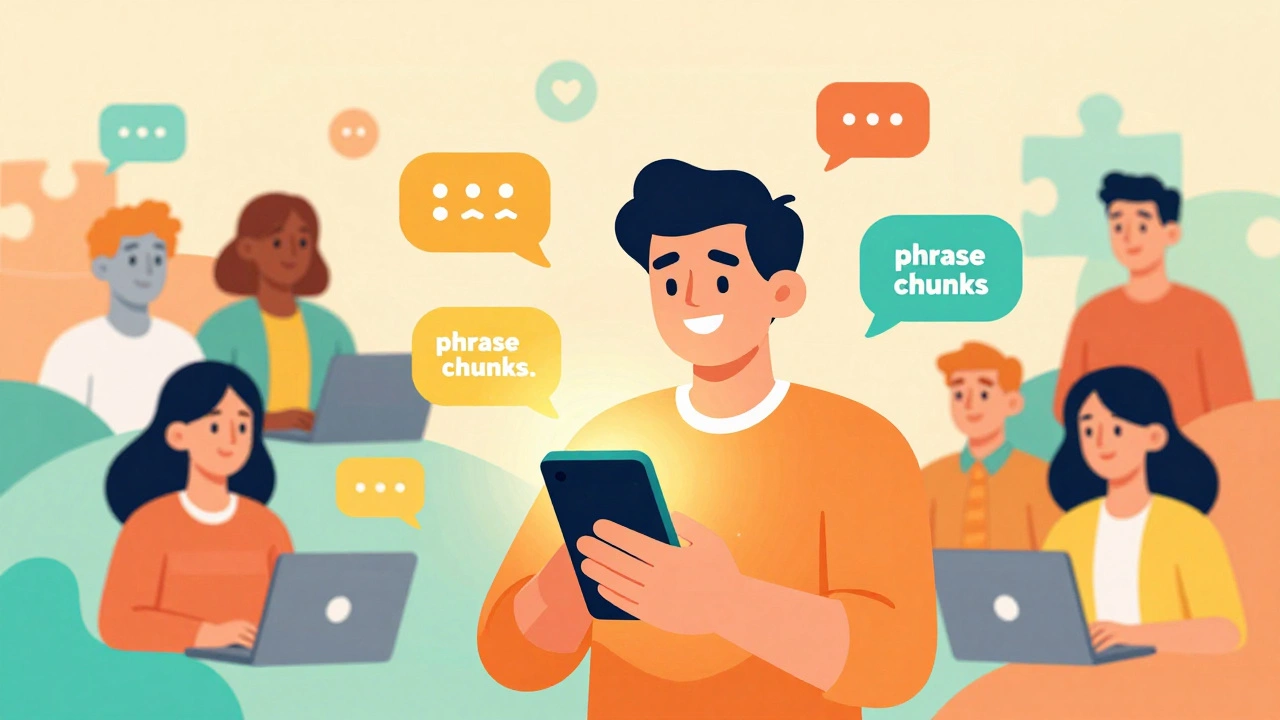
Relying on translation slows you down and increases anxiety. Instead of translating word-for-word, build a library of chunks-common phrases used together.
For example, instead of thinking "I" + "think" + "that" + "maybe," learn the chunk "I’m not sure, but..." or "From my perspective..." These chunks are stored in your brain as single units, allowing you to retrieve them quickly during conversation.
Create lists of phrases for specific scenarios:
- Agreeing: "That’s a good point," "I couldn’t agree more," "You’re right about that."
- Disagreeing politely: "I see your point, but..." "I’m not so sure about that."
- Buying time: "Let me think about that for a second," "That’s an interesting question."
Having these ready-made tools reduces cognitive load. You won’t panic when you need to respond because you already have the words prepared.
Leverage Technology for Feedback
In the past, finding feedback was hard. Today, technology provides instant correction. Use apps that offer speech recognition and AI-driven feedback.
Tools like speech-to-text software can be surprisingly useful. Dictate your thoughts into your phone. If the app misinterprets your words, it highlights areas where your pronunciation needs work. This objective feedback is less emotionally charged than human criticism.
Additionally, consider using AI chatbots designed for language learning. You can practice difficult conversations-like asking for a raise or resolving a conflict-with a bot that never judges you. This allows you to rehearse until you feel confident enough to try it with a real person.
Focus on Listening Comprehension
Speaking and listening are two sides of the same coin. Often, lack of confidence stems from fear of not understanding the other person. If you are constantly worried about missing information, you cannot focus on expressing yourself.
Improve your listening by consuming content slightly above your current level. Watch TV shows with subtitles, listen to news podcasts, or follow YouTube vloggers in your field of interest. The key is consistent exposure. As your ear becomes accustomed to the sounds of English, your brain processes input faster, freeing up mental resources for output.
Pay attention to connected speech. Native speakers link words together, drop sounds, and change vowel sounds. Recognizing these patterns helps you understand faster and mimic them naturally, boosting your overall fluency.
| Method | Best For | Difficulty Level | Key Benefit |
|---|---|---|---|
| Self-Talk | Beginners | Low | Zero social pressure |
| Shadowing | Pronunciation | Medium | Mimics native rhythm |
| Language Exchange | Intermediate | High | Real-time interaction |
| AI Chatbots | All Levels | Low | Instant, non-judgmental feedback |
Set Realistic Goals
Confidence grows when you achieve small wins. Setting vague goals like "become fluent" is overwhelming and unmeasurable. Instead, set specific, actionable targets.
For example:
- "I will speak English for five minutes every morning while getting ready."
- "I will order my coffee in English at least once a week."
- "I will join one online discussion forum per month."
Track your progress. When you see that you have spoken consistently for a month, your confidence will naturally rise. Consistency matters more than intensity. Ten minutes daily is better than two hours once a week.
Connect with a Community
Isolation breeds doubt. Surrounding yourself with supportive peers accelerates growth. Join local meetups, online clubs, or classes focused on English speaking skills.
In a group setting, you realize that everyone struggles. Hearing others make similar mistakes normalizes your own challenges. Plus, community members encourage each other, creating a positive feedback loop. Celebrate small victories together, and gently correct each other when asked.
Remember, confidence is a skill, not a trait. It is built through action, not thought. Start speaking today, embrace the awkwardness, and trust the process. Your ability to communicate will grow, one conversation at a time.
How long does it take to build confidence in speaking English?
There is no fixed timeline, as it depends on your starting level and practice frequency. However, most learners notice significant improvements in confidence within 4-6 weeks of consistent daily practice. The key is regular exposure rather than intense, sporadic study sessions.
Is it okay to mix languages when speaking English?
Yes, especially in early stages. Code-switching (mixing languages) is a natural strategy for maintaining flow. As your proficiency grows, you will rely on your native language less. Don't let the fear of mixing languages stop you from communicating.
What should I do if I freeze up during a conversation?
Take a deep breath and use filler phrases like "Let me think about that" or "Could you repeat that?" This buys you time to recover. Remember, pauses are natural in any conversation. Most listeners are patient and interested in what you have to say.
Can I improve my accent without formal training?
Absolutely. Techniques like shadowing and mindful listening can significantly improve your accent. Focus on clarity and intelligibility rather than sounding exactly like a native speaker. A distinct accent is not a barrier to effective communication.
Are online language exchanges better than in-person ones?
It depends on your comfort level. Online exchanges offer convenience and anonymity, which can reduce anxiety for beginners. In-person exchanges provide richer non-verbal cues and immediate feedback. Ideally, combine both for a well-rounded experience.