
IIT Seat & Rank Estimator (2026)
Your Profile
Seat Availability for General
Available Seats in Your Category
Rank Analysis
Loading analysis...
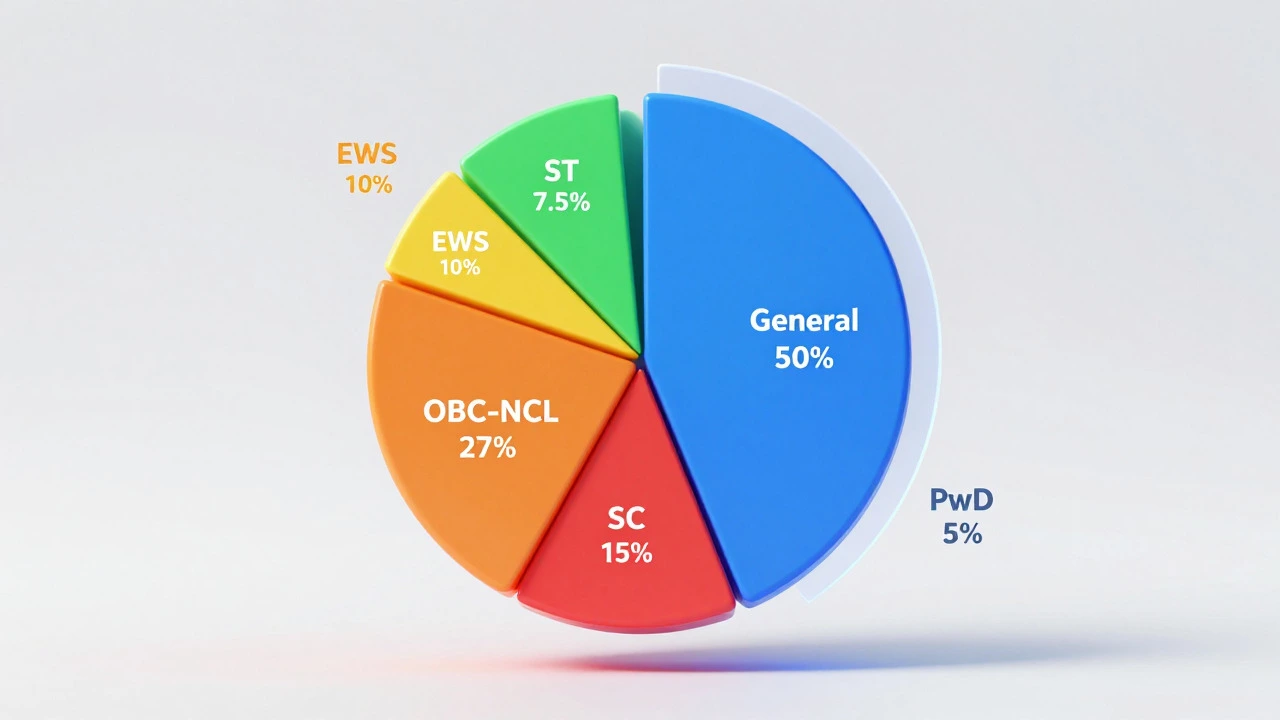
CATEGORY BREAKDOWN VISUALIZATION
Enter your details to see how many seats are available for you and analyze your admission probability.
You spend years grinding through physics problems, memorizing chemical reactions, and mastering calculus. The goal is clear: get into an Indian Institute of Technology. But when you finally look at the admission statistics, a confusing question pops up. How many IIT seats are there in India exactly? Is it 10,000? 20,000? Or something else entirely?
The number isn't just one static figure. It shifts every year based on policy changes, new campus expansions, and reservation quotas. For a student preparing for the JEE Advanced exam in 2026, understanding these numbers is as critical as solving a complex thermodynamics problem. Knowing the exact seat count helps you gauge your competition and set realistic target ranks.
The Big Picture: Total Seat Count in 2026
As of the 2025-2026 admission cycle, the total intake across all 23 IITs is approximately 10,800 to 11,000 seats for undergraduate programs. This number has been slowly climbing over the last decade. Back in 2015, the total was closer to 9,000. The government’s push to expand higher education infrastructure has added capacity, particularly in newer institutes like IIT Palakkad and IIT Dharwad.
However, "total seats" is a bit of a trap. Not every seat is open to every candidate. You need to break this down by category to understand your actual chances. The Ministry of Education mandates specific reservation policies that slice up the pie significantly.
| Category | Percentage | Approximate Seats |
|---|---|---|
| General (Open) | 50% | ~5,400 - 5,500 |
| EWS (Economically Weaker Sections) | 10% | ~1,080 - 1,100 |
| OBC-NCL (Non-Creamy Layer) | 27% | ~2,900 - 3,000 |
| SC (Scheduled Castes) | 15% | ~1,600 - 1,650 |
| ST (Scheduled Tribes) | 7.5% | ~800 - 825 |
| PwD (Persons with Disabilities) | 5% (Horizontal) | ~500 - 550 |
Note that the PwD quota is horizontal, meaning it cuts across all other categories. If you belong to the General category but have a qualifying disability, your seat comes from the General pool, not a separate bucket. This nuance often confuses students during counseling.
Why the Number Fluctuates Yearly
If you check data from 2023 versus 2026, you’ll see slight variations. Why? Because each IIT submits its proposed intake to the Ministry of Education annually. Several factors influence this:
- Infrastructure Readiness: New hostels or labs might come online, allowing a college to admit more students.
- Faculty Availability: You can’t admit students if you don’t have enough professors to teach them. Hiring freezes can cap seat counts.
- Demand vs. Supply: If certain branches like Computer Science are oversubscribed while Civil Engineering sees lower demand, institutes may tweak branch-wise allocations.
- New Institutes: When a new IIT gets established (like the recent additions in the Northeast), it starts with a small batch size that grows over time.
For example, IIT Hyderabad and IIT Bombay consistently have higher intakes due to their larger campuses and older establishment dates. In contrast, IIT Tirupati or IIT Gandhinagar might have smaller initial batches that gradually increase. Always check the latest JoSAA brochure for the exact numbers before you start filling choices.
Branch-Wise Allocation: The Real Bottleneck
Knowing the total seat count is useful, but knowing how those seats are distributed among branches is where the real strategy lies. Not all 11,000 seats are for Computer Science and Engineering (CSE).
In top-tier IITs like Bombay, Delhi, and Madras, CSE seats are fiercely contested. A single IIT might offer only 120-150 seats in CSE out of a total intake of 700+. That means less than 20% of their seats are for the most popular branch. The rest are spread across Mechanical, Electrical, Chemical, Metallurgy, Civil, Aerospace, and various interdisciplinary programs.
This creates a massive disparity in cutoff ranks. To get CSE at IIT Bombay, you might need an All India Rank (AIR) under 50. To get a decent branch at a newer IIT, you might need an AIR under 2,000. Understanding this distribution helps you decide whether to aim for a top college with a non-core branch or a mid-tier college with a core branch.
JoSAA Counseling: Where the Numbers Matter Most
The Joint Seat Allocation Authority (JoSAA) handles the admission process. They release a detailed brochure every June listing every single seat available. This document is your bible during preparation.
Here’s what you need to watch for in the JoSAA data:
- Home State Quotas: Some IITs reserve a percentage of seats for candidates from their home state. For instance, IIT Kharagpur reserves seats for West Bengal candidates. This reduces the pool for general applicants.
- NRI/Foreign National Seats: A small portion of seats (usually 10-15%) is reserved for Non-Resident Indians and foreign nationals. These seats are filled separately and don’t compete with domestic merit seats.
- TDF (Tuition Fee Waiver) Seats: While not reducing the total seat count, TDF availability affects financial planning for admitted students.
When you fill your choice filling form, you’re competing against thousands of others for these specific slots. The system allocates seats round by round. In Round 1, only the top ranks get their first preferences. By Round 4 or 5, the remaining seats are filled by lower ranks. Tracking the "last rank admitted" from previous years gives you a better sense of reality than just looking at total seats.
IIT vs. NIT vs. IIIT: The Bigger Context
Many students fixate solely on IITs. However, the National Institutes of Technology (NITs) and Indian Institutes of Information Technology (IIITs) also offer high-quality engineering education. Comparing seat counts puts things in perspective.
| Institute Type | Number of Institutes | Total Approx. Seats (UG) | Admission Exam |
|---|---|---|---|
| IITs | 23 | ~11,000 | JEE Advanced |
| NITs | 31 | ~25,000 | JEE Main |
| IIITs (Top 3) | 3 | ~1,500 | JEE Main |
Notice that NITs collectively have more than double the seats of IITs. If your primary goal is getting into a good government engineering college rather than specifically an IIT, expanding your focus to NITs significantly increases your probability of success. The quality of education at top NITs like Trichy, Warangal, and Surathkal is comparable to mid-tier IITs.
Strategic Takeaways for JEE Aspirants
So, how does this seat count data change your preparation strategy? Here are three actionable insights:
1. Target Your Rank, Not Just the College
Don’t just say "I want IIT." Say "I want an AIR under 1,000." Why? Because an AIR under 1,000 guarantees you a spot in a top IIT, likely in a core branch. An AIR between 1,000 and 5,000 still gets you into an IIT, but you might end up in a newer institute or a less popular branch. Use past year cutoffs to map ranks to outcomes.
2. Leverage Category Benefits Wisely
If you qualify for OBC-NCL, SC, or ST categories, ensure your documents are ready. The cutoff ranks for these categories are significantly lower. For example, an OBC candidate might secure a seat at IIT Kanpur with an AIR of 3,000, whereas a General category candidate would need an AIR under 500 for the same branch. Don’t ignore this advantage; plan your mock test analysis around category-specific percentiles.
3. Have a Backup Plan Beyond IITs
With only ~11,000 seats and hundreds of thousands of JEE Advanced qualifiers, the rejection rate is high. Prepare for JoSAA and CSAB special rounds, but also keep your options open with top private universities (like VIT, SRM, Manipal) or state-level engineering colleges. The gap between IIT and non-IIT is narrowing in terms of placement opportunities, especially in software roles.
Common Misconceptions About IIT Seats
Misconception 1: "More Seats Mean Easier Admission"
While total seats have increased, the number of qualified candidates has also risen. The difficulty level of JEE Advanced remains high. More seats don’t necessarily mean easier access; they just mean slightly more people get in.
Misconception 2: "All IITs Are Equal"
They aren’t. IIT Bombay and IIT Delhi have different brand values, alumni networks, and research funding compared to newer IITs. When analyzing seats, consider the institute’s age and reputation alongside the raw numbers.
Misconception 3: "Seat Count Includes Postgraduates"
The figures discussed here are strictly for Bachelor of Technology (B.Tech) and Bachelor of Science (B.Sc.) programs. M.Tech and PhD seats are separate and much fewer in number. Don’t mix these datasets when planning your undergraduate path.
What is the exact number of IIT seats in 2026?
The total approximate intake for undergraduate programs across all 23 IITs in 2026 is around 10,800 to 11,000 seats. This number varies slightly each year based on infrastructure and faculty availability. Always refer to the official JoSAA brochure for the precise, updated count.
How many seats are reserved for General category students?
Approximately 50% of the total seats are open to General category candidates. This translates to roughly 5,400 to 5,500 seats across all IITs. Additionally, 10% of seats are reserved for Economically Weaker Sections (EWS), which is a separate quota.
Do newer IITs have fewer seats than older ones?
Yes, generally. Older IITs like Bombay, Delhi, and Kanpur have larger intakes, often exceeding 700-800 students per year. Newer IITs like Palakkad or Dharwad started with smaller batches (around 200-300) and are gradually increasing their capacity as infrastructure develops.
Is the PwD quota separate from other categories?
No, the 5% Persons with Disabilities (PwD) quota is horizontal. It applies within each vertical category (General, OBC, SC, ST). For example, a PwD candidate from the General category competes for seats within the General 50% pool, not a separate PwD-only pool.
How do I find the seat count for a specific branch like Computer Science?
You need to check the JoSAA counseling brochure released in June. It lists the number of seats available for each branch at each institute. Typically, CSE constitutes about 15-20% of the total intake at major IITs, making it highly competitive.
Are there any seats reserved for NRI candidates?
Yes, each IIT reserves approximately 10-15% of its seats for Non-Resident Indians (NRIs) and Foreign Nationals. These seats are allocated through a separate counseling process and do not affect the merit-based allocation for domestic candidates.