
CBSE vs American Curriculum: Which Fits Your Child?
Student Profile Assessment
Answer these questions about your child's preferences and strengths to find their ideal educational path.
Why This Fits:
Key Strengths Aligned:
Is the Central Board of Secondary Education (CBSE) harder than an American high school curriculum? It’s a question that pops up constantly in international parent groups and among students weighing their options. The short answer is no, not exactly. One isn’t inherently "harder" than the other; they are simply different beasts. Comparing them is like asking if a marathon is harder than a sprint. Both require endurance, but they test your body in completely different ways.
If you’re trying to decide which path offers a better foundation for university or just wondering why your friend studying in Delhi seems buried under textbooks while your cousin in New York is juggling sports and clubs, you’ve come to the right place. Let’s break down the reality behind the hype.
The Breadth vs. Depth Divide
The biggest difference between CBSE is a standardized Indian curriculum known for its rigorous focus on core subjects like mathematics and sciences and the typical US High School American school system is a flexible educational model emphasizing holistic development, extracurriculars, and critical thinking over rote memorization lies in how they measure success.
In the CBSE system, depth is king. You go deep into specific subjects. If you choose Science, you aren’t just learning biology; you are mastering complex organic chemistry reactions and physics derivations that often rival first-year college courses in other countries. The syllabus is fixed, national, and unforgiving. There is little room for deviation. You study what is prescribed, you memorize it, and you reproduce it in exams with precision.
American schools, on the other hand, prioritize breadth and application. A student might take fewer advanced science classes but will likely participate in debate club, play varsity soccer, volunteer at a local shelter, and work on a group project that requires creative problem-solving rather than a single correct answer. The workload feels lighter in terms of pure hours spent studying textbooks, but the mental load of balancing academics with a packed extracurricular schedule can be exhausting in its own way.
How Assessment Defines Difficulty
Let’s talk about exams, because that’s where the pain usually sets in. In the CBSE framework, your final board exams at the end of Class 10 and Class 12 determine almost everything. These are high-stakes, pen-and-paper tests conducted simultaneously across India. The pressure is immense because one bad day can significantly impact your score, which directly affects your admission to top-tier universities like IITs or AIIMS.
This creates a culture of intense preparation. Students often attend coaching centers after school hours to practice solving thousands of problems. The difficulty here comes from the volume of content you must retain and the precision required in answering. A small calculation error in physics or a missed keyword in an English literature essay can cost you marks.
In contrast, American schools use continuous assessment. Your grade is a rolling average of homework, quizzes, midterms, projects, class participation, and finals. If you bomb a midterm, you can still recover by acing the final or doing well on daily assignments. This reduces the panic associated with any single test but increases the need for consistent effort throughout the year. You can’t cram for a week and coast for three months; you have to show up every day.
| Feature | CBSE (India) | American School System |
|---|---|---|
| Focus | Depth in core subjects (STEM/Humanities) | Breadth + Extracurricular balance |
| Assessment Style | High-stakes final board exams | Continuous grading (homework, projects, tests) |
| Learning Method | Rote memorization + Application | Critical thinking + Creative problem solving |
| Flexibility | Low (Fixed national syllabus) | High (Electives, AP/IB options) |
| University Entry | Based primarily on exam scores | Holistic review (GPA, essays, activities) |
The Role of Extracurriculars
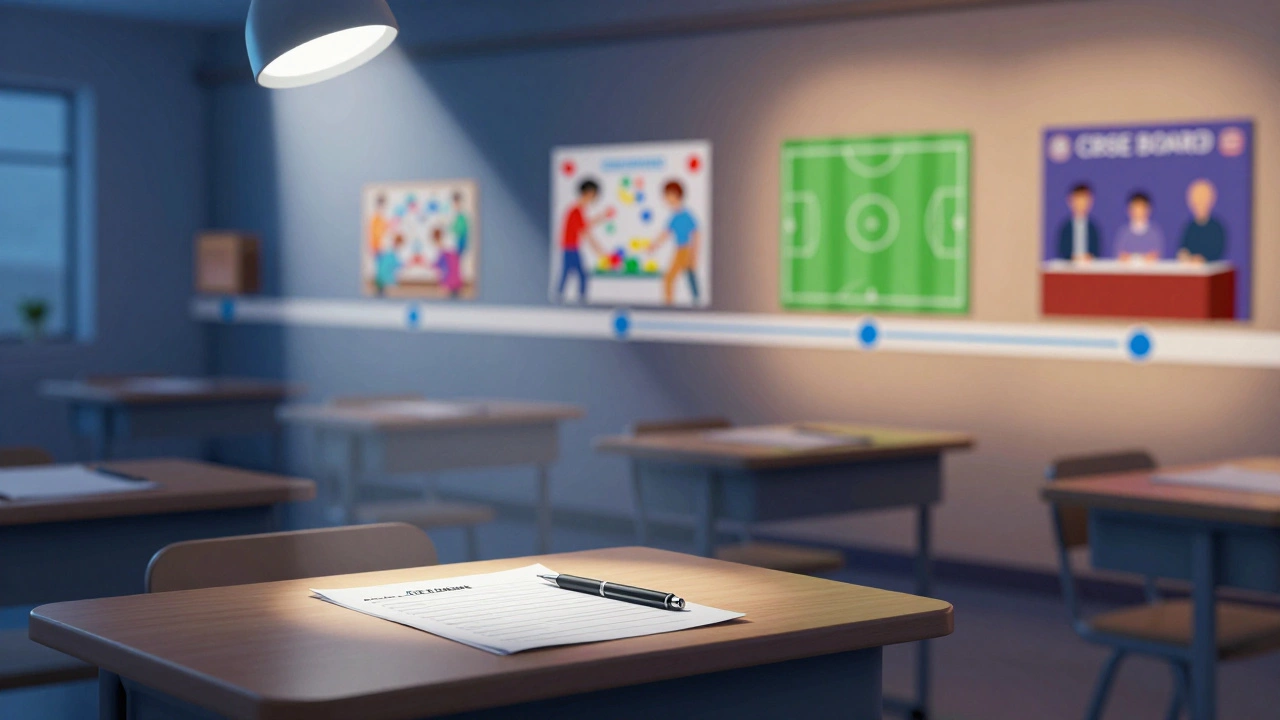
Here is where many parents get confused. They see American students playing football until 6 PM and think, "Wow, they have so much free time." But then those same students stay up late working on a robotics competition or writing a college application essay. In the US system, extracurriculars aren’t just hobbies; they are part of the academic portfolio. Top universities look for leaders, innovators, and community contributors, not just test-takers.
For a CBSE student, extracurriculars are often secondary. While schools do encourage sports and arts, the primary metric for success remains academic rank. A CBSE student might spend six hours a day in school and another four hours at a tuition center. Their "free time" is scarce. The difficulty lies in the sheer volume of academic material to cover. You are expected to know every theorem, every historical date, and every chemical formula inside out.
So, is it harder to be a CBSE student or an American student? It depends on what drains you more. Do you find it harder to memorize vast amounts of technical data under time pressure (CBSE), or do you find it harder to maintain high performance across multiple domains-academics, athletics, leadership, and creativity-simultaneously (American)?
Subject-Specific Challenges
Let’s look at specific subjects to see where the friction points lie.
Mathematics: CBSE math is notoriously rigorous. By Class 10, students are tackling calculus concepts, complex algebra, and geometry proofs that are often introduced later in US high schools. The pace is fast, and the expectation is mastery. In the US, math tracks vary widely. A student in a standard track might finish Algebra II by senior year, while an Advanced Placement (AP) Calculus BC student is doing college-level math. So, CBSE is generally harder than the *average* US math curriculum, but comparable to the *top-tier* AP tracks.
Sciences: Similar to math, CBSE science emphasizes theoretical understanding and numerical problem-solving. Physics involves heavy derivation work. Chemistry requires detailed knowledge of organic mechanisms. In the US, science classes often include lab work and project-based learning. The conceptual depth in CBSE is deeper, but the practical application skills developed in US labs can be more robust for certain career paths.
Languages and Humanities: This is where the American system often shines. US students write extensive essays, engage in Socratic seminars, and develop strong public speaking skills. CBSE students read literature and write answers, but the format is often more structured and less focused on original argumentation. If you value critical analysis and persuasive writing, the American approach feels more challenging because there is no single "right" answer to defend.
Which Path Prepares You Better for University?
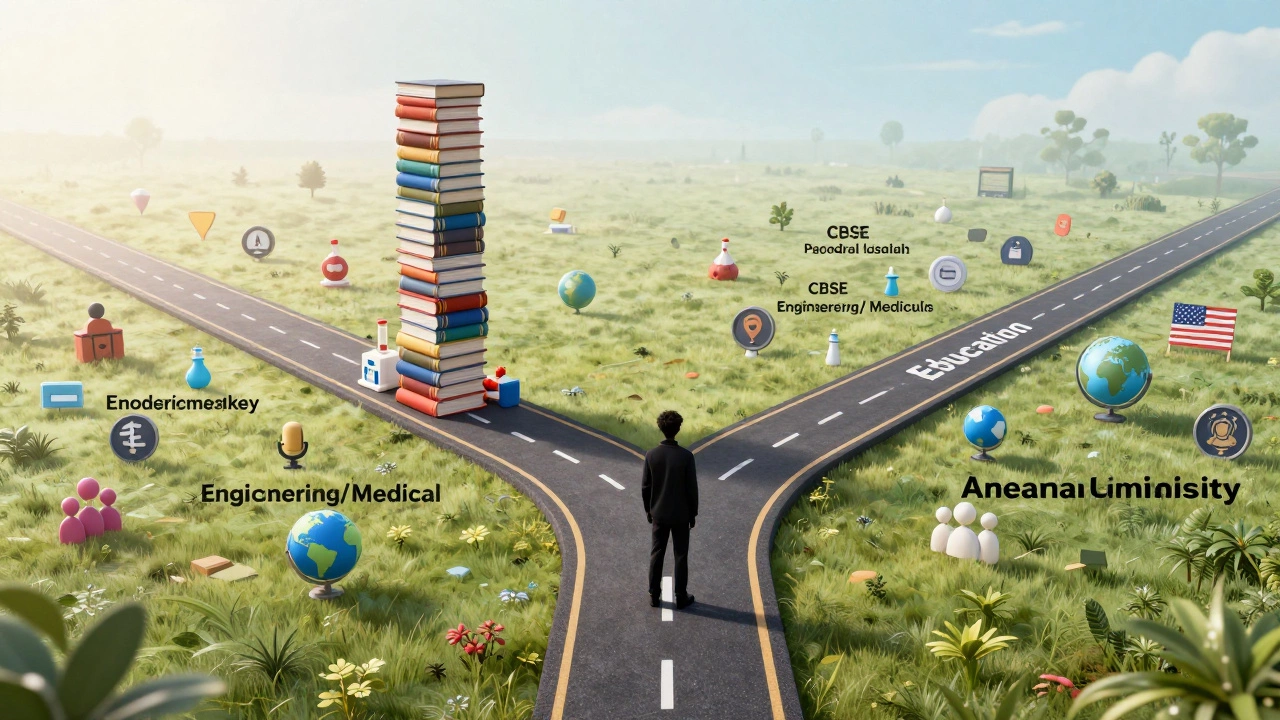
This is the ultimate question. If you plan to study in India, CBSE is the gold standard. It aligns perfectly with entrance exams like JEE and NEET. The discipline and foundational knowledge you gain are invaluable for competitive engineering and medical fields.
If you aim for universities in the US, UK, Canada, or Australia, the American high school experience provides a smoother transition. Western universities expect students who can collaborate, present ideas, manage independent projects, and think critically outside the textbook. A CBSE student may struggle initially with the lack of structure and the emphasis on self-directed learning, even though their academic foundation is rock-solid.
However, don’t underestimate the resilience of a CBSE graduate. Having survived the pressure cooker of board exams, they often adapt quickly once they understand the new rules of engagement. Conversely, an American student moving to a rigid system might find the lack of flexibility stifling.
Making the Right Choice for Your Child
So, which one should you choose? It boils down to your child’s personality and your family’s goals.
- Choose CBSE if: Your child thrives on structure, excels in STEM subjects, enjoys deep diving into topics, and handles high-pressure testing environments well. It’s also the best choice if you plan to return to India for higher education or employment.
- Choose an American-style curriculum if: Your child is creative, socially active, learns best through discussion and projects, and wants to keep options open for global universities. It suits kids who need variety to stay motivated.
Neither system is objectively "harder." They are designed to produce different types of thinkers. CBSE produces specialists with strong foundational knowledge. American schools produce generalists with strong adaptive skills. In today’s global job market, both skill sets are valuable. The key is matching the environment to the individual.
Is CBSE recognized internationally?
Yes, CBSE is widely recognized globally. Many universities in the US, UK, Canada, and Australia accept CBSE Class 12 results for admission. However, some may require additional standardized tests like SAT or ACT, especially for US institutions, as they are used to evaluating GPA and extracurricular profiles rather than just board exam scores.
Can a CBSE student switch to an American school easily?
It is possible but can be challenging. The main hurdle is adjusting to the teaching style. CBSE students are used to teacher-led instruction and clear right/wrong answers. American classrooms often require more self-initiation, group work, and subjective analysis. Additionally, credit transfer can be tricky depending on the specific subjects taken. Most schools offer placement tests to determine the appropriate grade level.
Are American schools easier academically?
Not necessarily. While the average workload might feel lighter due to less rote memorization, top-tier American schools offering AP (Advanced Placement) or IB (International Baccalaureate) programs are extremely rigorous. The difficulty shifts from memorizing facts to applying concepts creatively and managing a diverse set of responsibilities. For high-achieving students, the academic challenge in a good American school is comparable to CBSE.
Which curriculum is better for engineering?
If you plan to take the JEE (Joint Entrance Examination) in India, CBSE is essential because its syllabus aligns closely with JEE requirements. For engineering abroad, either curriculum works, but CBSE provides a stronger mathematical and scientific foundation early on. American students often need to take extra math/science courses in college to catch up to the depth covered in Indian high schools.
Do CBSE students face more stress?
Generally, yes, particularly around board exam seasons. The stakes are higher because a single exam determines future opportunities. American students face chronic stress from balancing academics with sports, clubs, and college applications, which is a year-round process. The type of stress differs: acute pressure for CBSE versus sustained multitasking for American students.