CBSE Enrollment & Comparison Explorer
Explore the vast network of the Central Board of Secondary Education (CBSE). Use the tabs below to view enrollment stats, regional breakdowns, and comparisons with other major Indian boards.
Key Insight
Only students in Class X and XII take external board exams. Classes I-IX and XI use internal school assessments aligned with CBSE guidelines. This explains the gap between total enrollment (~21M) and exam takers (~2.75M).
Exam Taker Breakdown
Estimated Regional Share of CBSE Enrollment
| Region / State Type | Share | Characteristics |
|---|---|---|
| Delhi NCR & Haryana | ~25% | Highest density due to central govt jobs & corporate hubs. |
| Eastern & Northern India | ~25% | Rapid growth in tier-2/3 cities adopting CBSE for standardization. |
| Southern States | ~20% | Growing urban preference despite strong state board traditions. |
| Maharashtra & Gujarat | ~15% | Industrial presence drives demand for English-medium education. |
| International Schools | ~15% | Popular among expatriate communities and global affiliates. |
CBSE vs. Other Major Boards
Comparing annual board examination candidates (approximate figures).
Why Does Size Matter?
With ~10x more students than CISCE, CBSE has a massive ecosystem of resources, coaching centers, and peer support groups. For ed-tech companies, this defines the Total Addressable Market (TAM). However, it also means higher competition for top percentiles in college admissions.
Imagine a stadium packed with over 20 million people. That’s roughly the number of students currently registered under the Central Board of Secondary Education (CBSE) in India. It is not just a large number; it represents one of the largest educational networks on the planet. If you are a parent weighing options, a researcher tracking demographic shifts, or an educator analyzing market trends, knowing exactly how many students sit for these exams matters. The sheer scale impacts everything from infrastructure planning to job market competition.
The answer isn't a single static number because it changes every academic year. However, recent data paints a clear picture. For the academic session 2023-2024, the total enrollment across all affiliated schools hovered around 21 to 22 million students. This figure includes everyone from Class I through Class XII. When we narrow it down to those actually appearing for board examinations-Class X and Class XII-the number drops significantly but remains massive, typically ranging between 2.5 to 3 million candidates annually.
Breaking Down the Numbers by Class Level
You might wonder why there is such a gap between total enrollment and exam takers. It comes down to structure. Not every student takes the board exams. Only students in Class X and Class XII do. The rest are part of the internal assessment system within their respective schools. Understanding this distinction helps clarify what "CBSE students" really means depending on who you ask.
Let's look at the typical distribution based on recent annual reports from the Ministry of Education and CBSE official bulletins:
- Total Affiliated Schools: Approximately 28,000 to 30,000 institutions.
- Total Enrolled Students (I-XII): Roughly 21-22 million.
- Class X Candidates: Usually between 1.8 to 2 million students per year.
- Class XII Candidates: Typically between 1.2 to 1.4 million students per year.
Notice that Class X usually has more candidates than Class XII. Why? Because some students drop out after completing secondary education, while others switch boards or pursue vocational training before reaching the senior secondary level. This attrition rate is a critical metric for policymakers trying to improve retention rates in higher secondary education.
Why Do These Numbers Matter?
It is easy to dismiss these figures as just trivia. But think about the logistics. Processing registration forms, printing question papers, arranging examination centers, and evaluating millions of answer sheets requires an army of staff. In 2024 alone, CBSE conducted exams in over 7,000 centers globally. If the student count spikes unexpectedly, the entire machinery strains.
For private investors and ed-tech companies, these numbers define the total addressable market. A platform offering mock tests for CBSE Class XII knows its potential user base is capped at around 1.3 million active users during peak season. This specificity allows for better resource allocation. You don't build a server capacity for 20 million if only 1.3 million will log in simultaneously during exam week.
Regional Distribution of CBSE Students
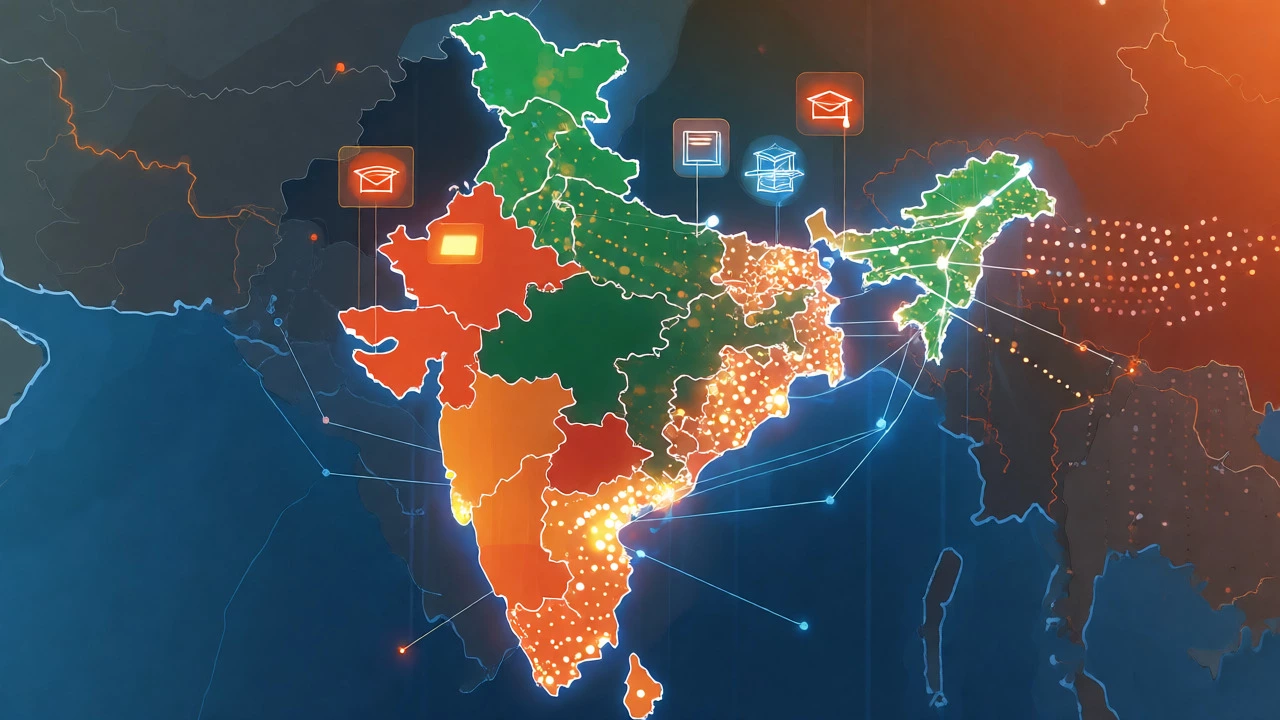
Geography plays a huge role here. While CBSE is a national board, its popularity varies wildly across states. Some regions rely heavily on state boards, while others prefer CBSE for its uniformity and recognition abroad.
| Region/State Type | Approximate Share of Total CBSE Students | Key Characteristics |
|---|---|---|
| Delhi NCR & Haryana | ~25% | Highest density of affiliated schools due to central government jobs and private sector hubs. |
| Maharashtra & Gujarat | ~15% | Strong industrial presence drives demand for English-medium CBSE education. |
| Southern States (Karnataka, TN, Kerala) | ~20% | Growing preference in urban areas despite strong state board traditions. |
| Eastern & Northern India | ~25% | Rapid growth in tier-2 and tier-3 cities adopting CBSE for standardization. |
| International Schools | ~15% | CBSE is popular among expatriate communities and international affiliates. |
This table highlights a crucial trend: urbanization drives CBSE adoption. Families moving to metros for work often prioritize CBSE because it facilitates transfer between cities without changing curricula. If your child moves from Mumbai to Delhi mid-year, switching from a Maharashtra State Board syllabus to CBSE can be jarring. Staying with CBSE avoids that friction.
How Does CBSE Compare to Other Boards?
To truly understand the scale, you need context. How does CBSE stack up against the Council for the Indian School Certificate Examinations (CISCE) or various state boards?
CISCE, which conducts ICSE and ISC exams, serves a much smaller niche. Estimates suggest CISCE enrolls roughly 2 to 3 million students in total, with only about 200,000 to 300,000 taking board exams annually. That makes CBSE nearly ten times larger in terms of board exam volume. This difference explains why CBSE resources, sample papers, and coaching materials are far more abundant and cheaper than their CISCE counterparts.
State boards collectively educate the majority of Indian students. The Uttar Pradesh Madhyamik Shiksha Parishad (UPMSP), for instance, conducts exams for over 2.5 million students alone. However, because each state operates independently, comparing them directly to CBSE is tricky. CBSE offers a unified national benchmark, whereas state boards vary in difficulty, grading systems, and language mediums.
Trends Influencing Future Enrollment
The numbers aren't static. Several factors are pushing enrollment figures upward. First, the National Education Policy (NEP) 2020 encourages multidisciplinary learning. Many state boards are slowly aligning with CBSE frameworks to offer similar flexibility. As this alignment happens, some parents may perceive CBSE as the 'original' source of these reforms, boosting its appeal.
Second, digital accessibility has lowered barriers. During the pandemic, CBSE accelerated its online initiatives. Today, even remote villages have access to high-quality CBSE-aligned content via smartphones. This democratization means students who previously couldn't afford city-based CBSE schools can now access the curriculum remotely or through local affiliated institutions.
Third, international mobility. With increasing global migration, families want qualifications recognized worldwide. CBSE results are widely accepted by universities in the US, UK, Canada, and Australia. This portability attracts aspirational middle-class families who see education as a ticket to global opportunities.

Common Misconceptions About CBSE Numbers
A frequent error is confusing "students studying CBSE syllabus" with "students registered with CBSE." Thousands of non-affiliated schools teach the CBSE curriculum but don't register students for board exams. They follow the pattern but operate independently. So, if you hear claims of "30 million CBSE learners," they likely include these unofficial adopters. The official registered count remains closer to 21-22 million.
Another myth is that CBSE is only for wealthy urbanites. While historically true, the expansion into semi-urban and rural areas has changed the demographic profile. Government schools affiliated with CBSE now serve millions of lower-income students, broadening the socioeconomic base significantly.
Practical Implications for Parents and Students
So, what does all this mean for you? If you are choosing a board, consider the support ecosystem. With 2+ million peers, finding study groups, online forums, and tutoring help for CBSE is effortless. You will never feel isolated. Conversely, if you choose a less common board, you might struggle to find specific past paper solutions or specialized coaching.
Also, keep an eye on competition ratios. In certain competitive streams like Science for Class XII, the sheer volume of students means top percentiles require exceptional performance. Knowing that 1.3 million students are competing for limited seats in prestigious colleges adds perspective to your preparation strategy.
What is the exact current number of CBSE students?
As of the latest available data for the 2023-2024 academic year, there are approximately 21 to 22 million students enrolled across all classes (I-XII) in CBSE-affiliated schools. Of these, around 2.5 to 3 million students appear for the Class X and Class XII board examinations annually.
Which state has the most CBSE students?
Delhi-NCR and Haryana together account for the highest concentration of CBSE students, representing roughly 25% of the total enrollment. This is due to the high density of central government employees and private corporate sectors in these regions.
Is CBSE bigger than ICSE?
Yes, CBSE is significantly larger. CBSE enrolls roughly 10 times more students than the CISCE board (which runs ICSE). While CBSE has over 2 million board exam candidates, CISCE typically has fewer than 300,000.
Do all CBSE students take board exams?
No. Only students in Class X and Class XII take external board examinations. Students in Classes I to IX and XI undergo internal assessments conducted by their respective schools, though these must align with CBSE guidelines.
How many CBSE affiliated schools are there?
There are approximately 28,000 to 30,000 schools affiliated with CBSE in India and abroad. This number fluctuates slightly each year as new schools apply for affiliation and others close or change boards.