Education Path Finder
What is your primary goal? Select the option that best describes your current needs to see the recommended path.
I just want the knowledge
I don't need a piece of paper, just the skills.
I need a career skill
I want a recognized certificate to show employers.
I need a full degree
I need a verified diploma for a professional license.
I want the cheapest path
I want to minimize time and money spent.
Recommended: Open Courseware (OCW)
Since you only need the knowledge, MIT OpenCourseWare or Harvard's free materials are perfect. You get Ivy-League content for $0 without the pressure of exams or tuition.
- Cost: $0
- Credential: None
- Best for: Self-learners and hobbyists
Recommended: MOOCs & Professional Certificates
Look into platforms like Coursera or edX. Audit the courses for free to learn, and seek financial aid for the certificates from providers like Google or IBM.
- Cost: Free to Low
- Credential: Professional Certificate
- Best for: Career switchers in tech/marketing
Recommended: Sponsorships & Grants
A full degree requires institutional backing. Check your Employee Handbook for tuition reimbursement or apply for Pell Grants and state-specific scholarships.
- Cost: Potentially $0 (if funded)
- Credential: Full Accredited Degree
- Best for: Licensed professions/Government jobs
Recommended: The Hybrid 'Hack' Strategy
Combine CLEP exams (to test out of basics) with a Competency-Based Education (CBE) program like WGU to finish your degree in record time for a fraction of the cost.
- Cost: Very Low
- Credential: Full Accredited Degree
- Best for: Motivated students who already have some knowledge
Quick Takeaways
- Accredited degrees are rarely 100% free, but tuition-free options exist through specific scholarships and government programs.
- Open Courseware allows you to learn everything in a degree for free, even if you don't get the piece of paper.
- Alternative paths like CLEP and DSST let you earn credits for free or cheap, slashing the cost of a final degree.
- Many 'free' programs are actually 'low-cost' or 'performance-based.'
The Big Distinction: Degree vs. Learning
Before you spend hours searching, you need to understand a crucial difference. There is a massive gap between learning the material for free and getting the credential for free. Open Courseware is a publication of educational materials by institutions like MIT and Harvard that allows anyone to access their entire curriculum online without paying. This means you can study the exact same Physics or Economics course as a student at a prestigious Ivy League school. You get the knowledge, the readings, and the lecture videos. However, you don't get the degree. Why? Because the value of a degree isn't just the knowledge; it's the verification that you actually learned it, which requires a proctored exam and administrative oversight.
If your goal is to switch careers into something like data analysis or digital marketing, you might not actually need the degree. Many employers today value a portfolio of work over a diploma. In that case, MOOCs (Massive Open Online Courses) via platforms like Coursera or edX are your best bet. These platforms partner with universities to provide high-quality instruction. While they offer 'audit' modes for free, they usually charge a small fee for the certificate. It's not a full degree, but it's a recognized signal to a recruiter that you've mastered a specific skill.
How to Actually Get a Tuition-Free Degree
If you absolutely need the piece of paper-perhaps for a government job or a licensed profession-you can't just rely on a website. You need a structural way to eliminate the cost. The most reliable method is finding a Tuition-Free College model. Some institutions, especially niche religious or community-focused colleges, operate on an endowment model where donors pay the tuition so the students don't have to. These are rare and often have strict admission requirements.
Another route is through Employer Sponsorship. Many companies, from Starbucks to Amazon, have partnerships with universities. They pay 100% of the tuition for employees to earn degrees in fields that benefit the company. If you are currently working, check your employee handbook. You might be sitting on a goldmine of free education that you didn't even know existed. This is effectively a free degree, provided you stay with the company for a set period.
For those in the US, there are government-funded paths like the Pell Grant, which is federal funding for students with exceptional financial need. While not a "free degree" in the institutional sense, a combination of Pell Grants and state-specific scholarships (like the HOPE scholarship in Georgia) can result in a net-zero cost for the student.
| Path | Cost | Credential | Effort Level | Best For |
|---|---|---|---|---|
| Open Courseware | $0 | None | High (Self-Guided) | Knowledge Seekers |
| MOOCs (Audit) | $0 | None/Small Fee | Medium | Skill Upgrading |
| Employer Sponsored | $0 | Full Degree | High (Work + Study) | Career Climbers |
| Grant-Funded | $0 - Low | Full Degree | High (Academic) | Full-time Students |
The "Hack" Path: Credits via Testing
There is a way to get a degree for a fraction of the cost, which is almost as good as free. It's called credit by examination. Instead of paying for a 16-week course that costs $2,000, you can take a test to prove you already know the material. CLEP (College-Level Examination Program) allows you to earn college credits by passing a comprehensive exam. If you are naturally good at a subject, you can essentially 'skip' the cost of that class.
Combine this with a Competency-Based Education (CBE) model, and the cost drops even further. CBE schools, like Western Governors University, charge by the term rather than by the credit. This means if you are fast and can pass your classes in two months instead of four, you pay significantly less. Some students have managed to finish entire degrees in two years for under $10,000 by stacking CLEP credits and sprinting through a CBE program.
Warning Signs: How to Spot Degree Scams
When you search for 'free online degrees,' you will encounter a lot of noise. Be extremely careful with sites that promise a degree for free just for 'signing up' or 'watching videos.' If a site isn't linked to a recognized university or a government body, the certificate they give you is likely worthless in the job market. Always check for Regional Accreditation. In the US, this means the school is recognized by a body like the Higher Learning Commission. If a 'free' degree program cannot name its accrediting body, walk away.
Another red flag is the 'Diploma Mill.' These sites sell pieces of paper that look official but have no academic backing. They often use names that sound like famous universities (e.g., "University of Oxford-Online Global" instead of the actual University of Oxford). A real degree requires work, assessment, and a verified institution. If it feels too easy, it's probably a scam.
Alternative Credentials: The New Degree
We are seeing a shift where Micro-credentials and Nanodegrees are becoming acceptable. Companies like Google and IBM offer professional certificates through Coursera. While not technically a 'degree,' these are designed by the companies that actually do the hiring. They focus on specific, high-demand skills like Cybersecurity or Project Management. For many, these are more valuable than a general liberal arts degree from a mediocre college, and they are often available via financial aid that makes them free.
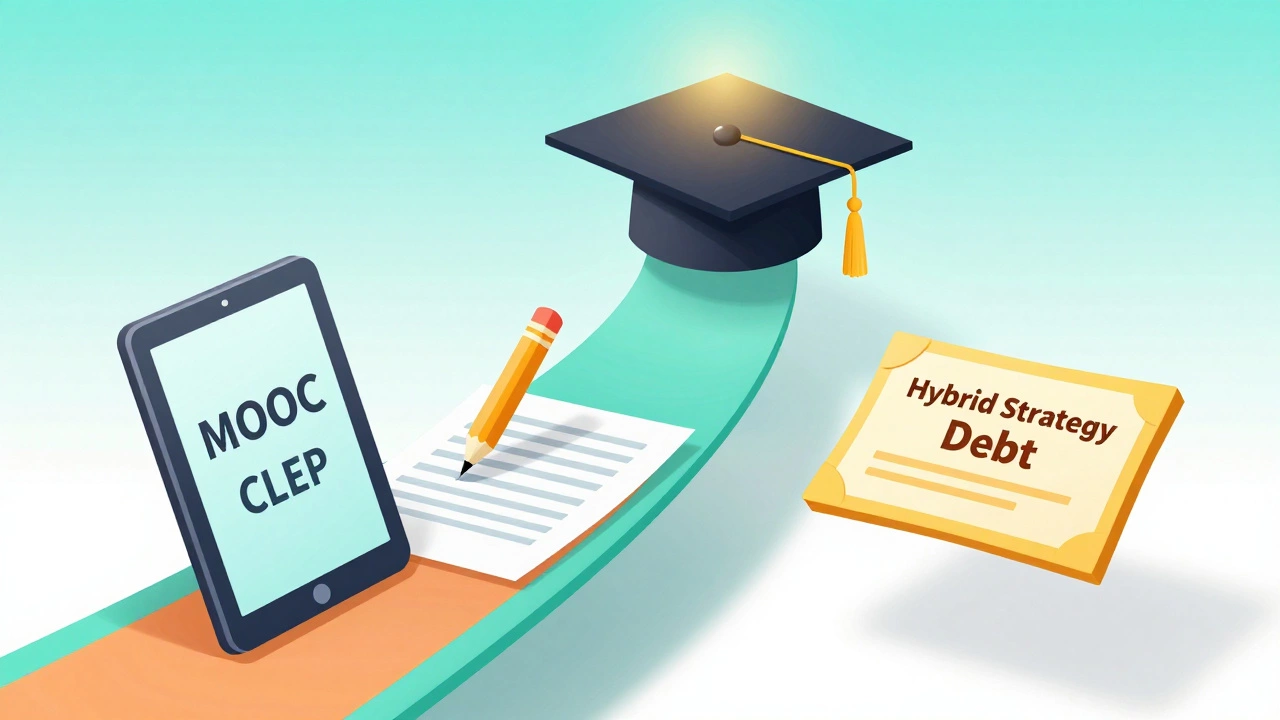
If you are determined to avoid debt, don't look for a 'free degree' as a single product. Instead, look for a hybrid strategy: use Open Courseware to learn, CLEP exams to get cheap credits, and employer benefits or grants to cover the final diploma costs. This is the only realistic way to get a high-value credential without spending a fortune.
Can I get a free degree from Harvard or MIT?
No, you cannot get a formal degree from these institutions for free. However, you can access their Open CourseWare and edX platforms to learn their curriculum for free. You will gain the knowledge, but you won't receive a diploma unless you enroll as a full-paying student and complete the degree requirements.
Are MOOC certificates recognized by employers?
Yes, but usually as a supplement to a degree, not a replacement for one. A certificate from Google or IBM in a specialized field (like Data Analytics) is highly regarded for specific technical roles, but it doesn't carry the same weight as a Bachelor's degree for general management or licensed professional roles.
What is the difference between a free course and a free degree?
A free course gives you access to information and instruction. A free degree provides the credential-a verified document stating you have completed a full program of study. Most 'free' online options are courses; very few are full degrees because the accreditation process is expensive for universities to maintain.
How do I find out if my employer pays for college?
Check your employee handbook or the 'Benefits' section of your company's internal HR portal. Look for terms like "Tuition Reimbursement" or "Education Assistance." If you don't see it, send a polite email to your HR representative asking if the company offers any educational partnerships or tuition support.
Is it possible to get college credit for free?
Not entirely free, but very cheap. Programs like CLEP allow you to take a test for a small fee (usually around $90) to earn credits that would otherwise cost thousands of dollars in tuition. Some community colleges or employer programs even reimburse the cost of these exams, making them effectively free.